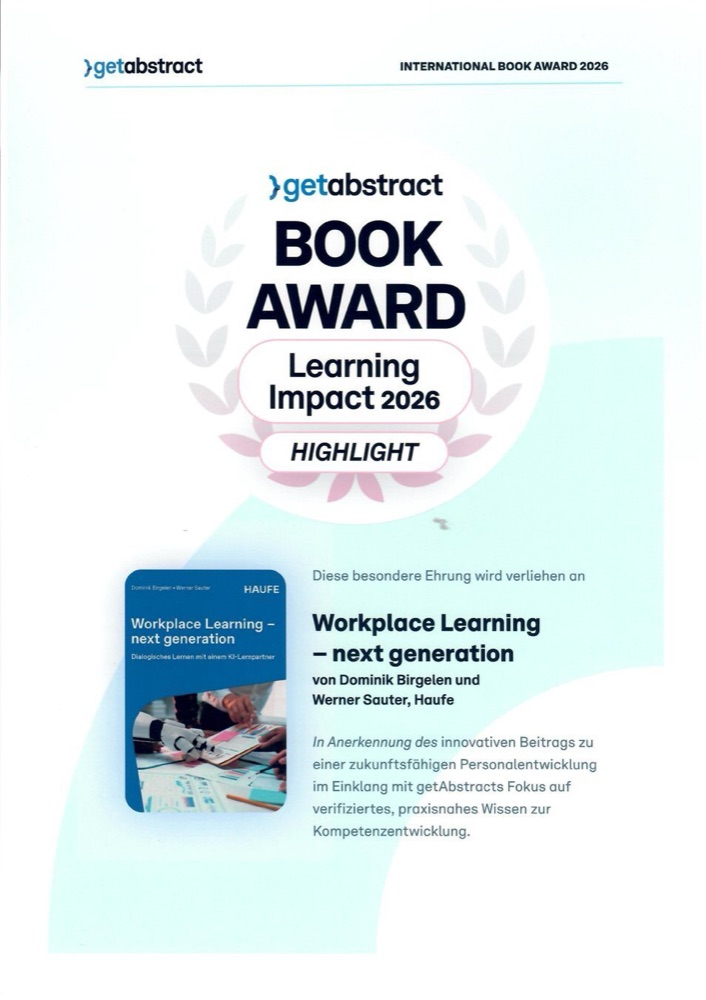
Our concept for the future of learning convinces.
getAbstract has honored our latest professional book with the International Book Award 2026 – Learning Impact as a “Highlight”.
The book Workplace Learning – next generation – Dialogic Learning with an AI Learning Partner, written by our oneclick AG CEO Dominik Birgelen and our scientific director Prof. Dr. Werner Sauter, was selected “in recognition of its innovative contribution to future-ready human resources development”.
It describes the fundamental shift in corporate learning, away from imparting knowledge and qualifications in advance, toward the targeted development of values and competencies in the work process – in dialogue with artificial intelligence.
This concept forms the conceptual foundation for our ValCom® solutions Diagnostics, Studio and Learning.
We build a foundation for continuous development.
Working and learning grow together.
Skills gaps are seen by 63% of employers as a key barrier to transformation.
WEF Future of Jobs Report 2025 ↗of employees' required core competencies will change by 2030. A competency model built once becomes outdated within a short time.
WEF Future of Jobs Report 2025 ↗of employees actually apply what they learned in further-education programs at the workplace.
Harvard Business Review, 2019 ↗What was learned gets recorded – not how people act. Certificates and hard skills show what a person is qualified for – not how they decide in new, unclear situations and take responsibility. That is exactly what decides success in a role, and hardly anyone measures it.
Just 2.5 days per employee per year are available for further education.
Anyone who ties competency development to fixed dates underestimates the pace of change in their own industry.
People have long since been learning elsewhere: two-thirds of corporate learning happens informally. The most important form of learning is learning within the work process – three times as much as classic, formal further education.
So the learning is already happening at the workplace. It is just not planned in a structured way and nobody accompanies it. This is exactly where ValCom comes in.
Total economy Germany, 20.3 hours per year
Formal learning accounts for 9.4 percent of total learning time – just under two hours per year. Calculated per working day: a quarter of a day.
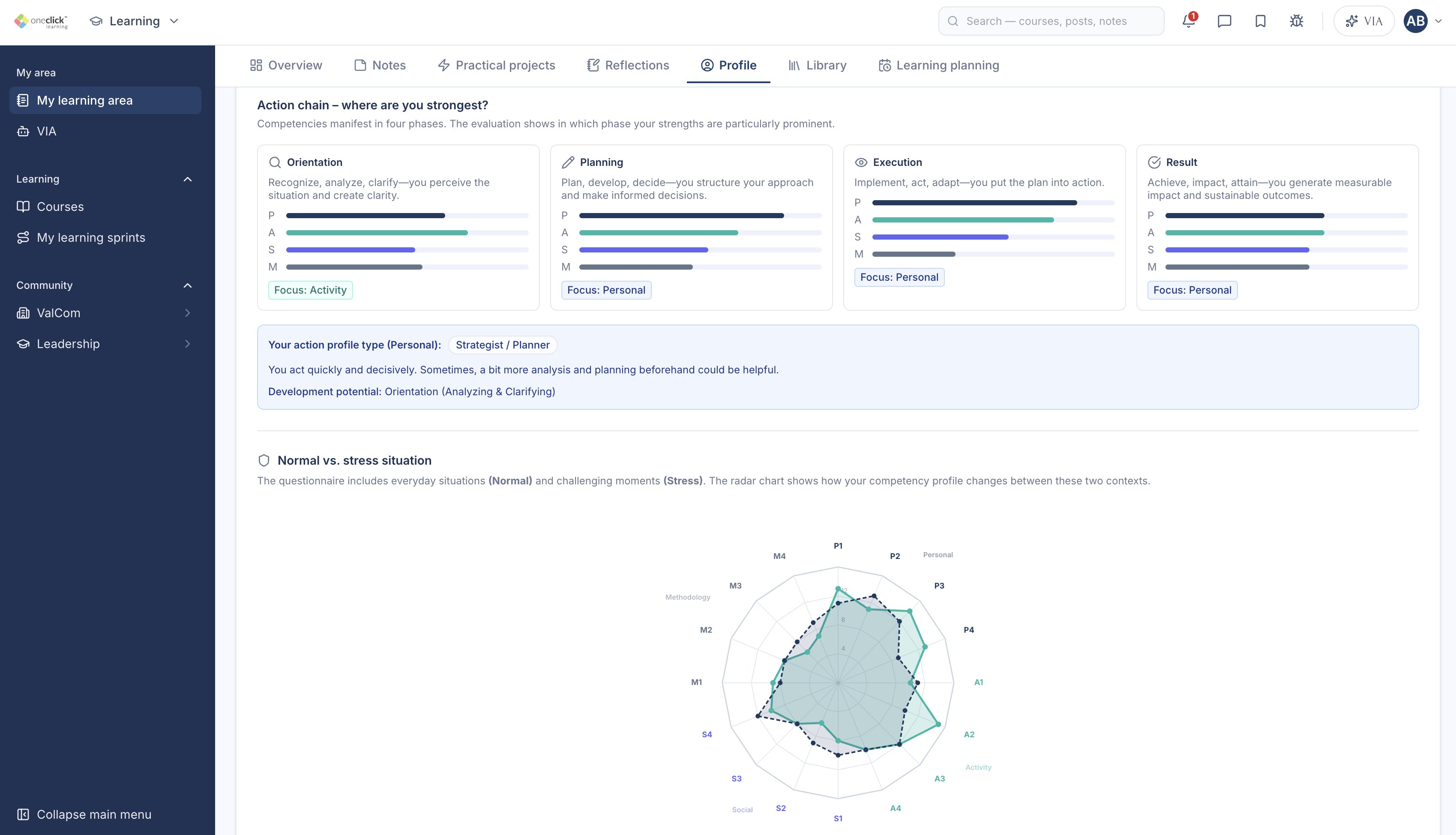
The suite links diagnosis, learning paths and practical projects in learning sprints – so competencies are developed with purpose and progress becomes visible
A chain of modules that build on one another.
ValCom Diagnostics
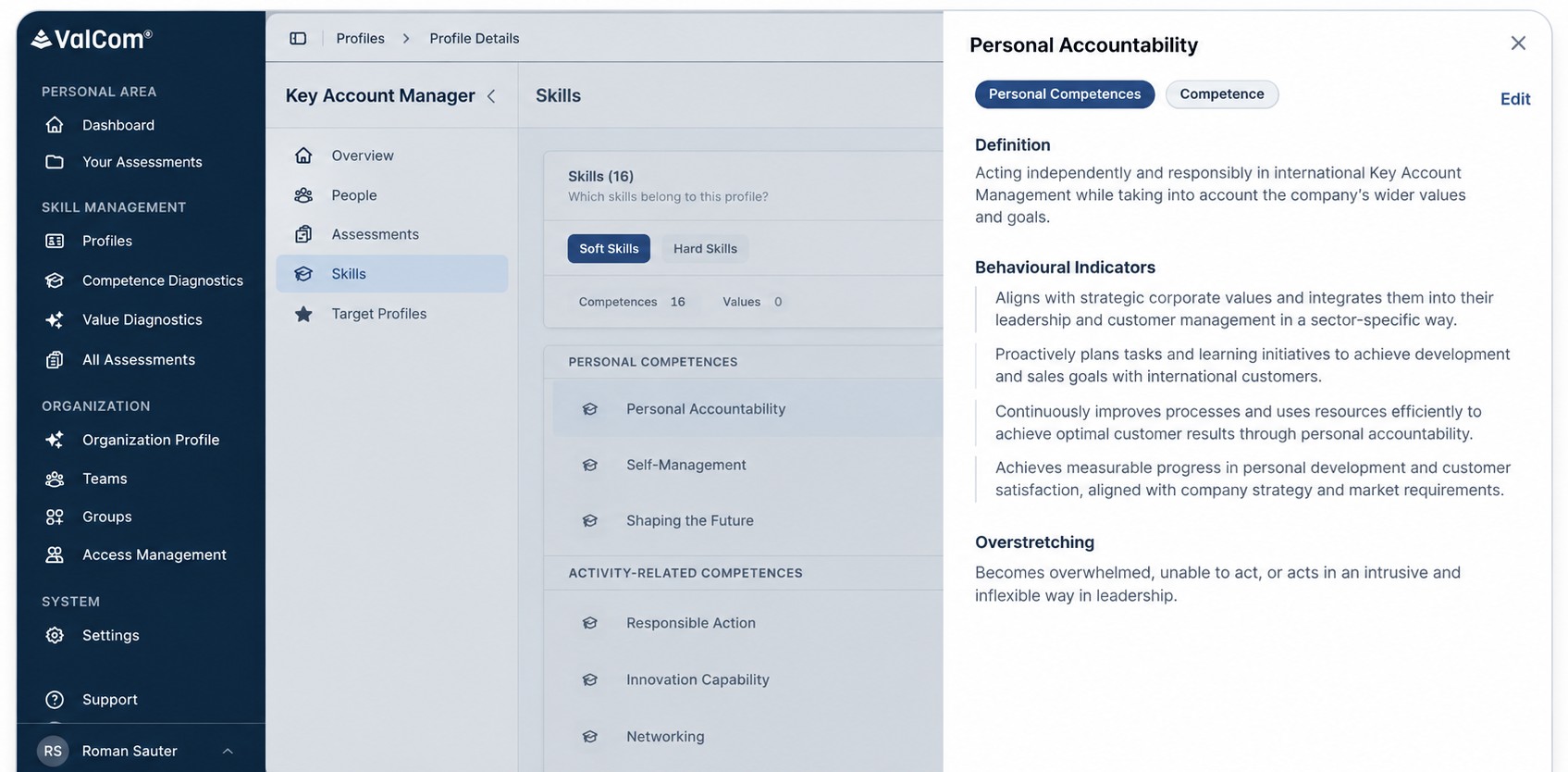
The AI derives competency models from job profiles and labor market data, in hours instead of months. Self- and 360° assessments show skills gaps and learning recommendations.
See Diagnostics →ValCom Learning
A learning path with dynamic learning sprints emerges from a diagnosis or a challenge. VIA (ValCom Intelligent Agent) accompanies as a Socratic learning partner.
See Learning →ValCom Studio
The AI builds complete courses from your documents: lessons, quizzes, scenarios, podcasts and videos – source-faithful and adjustable.
See Studio →ValCom Skills Mapping
Data-driven forecasts, comparisons, potential analyses and heatmaps with hard and soft skills at every level.
Diagnostics is available. Learning and Studio launch in the starter offer.
How ValCom makes the difference: competency development from your knowledge and your work tasks
Individual learning paths emerge from your materials and requirements. VIA accompanies implementation in everyday work and supports reflection.
Develop specialists and managers
Strengthen specialist and leadership competencies through real tasks and make progress visible through accompanying diagnostics.
Take on new responsibility
Grow into new roles in a targeted way with matching practical tasks and VIA as a learning partner.
Shape change
Derive matching competency profiles and individual development goals from changed requirements.
Strengthen consulting competencies
Use your own methods and concrete consulting cases to further develop your personal consulting competency.
Around 390 competencies and 509 values – scientifically grounded
The foundation is the competency model by Prof. Dr. John Erpenbeck and Prof. Dr. Werner Sauter – the result of over 25 years of research. Every competency and every value comes with a definition, concrete behavioral anchors, a description of the exaggerated form, and stored development recommendations.
Not "this is who I am", but "this is how I act"
Personality tests measure traits that are barely changeable. We diagnose developable attitudes and capacities to act. That is the difference between a label and a development path.
Others let the AI guess
Many systems let a language model freely interpret what competency means. With us, a researched, published model lies underneath: four areas, 16 fields, complemented by the necessary hard skills.

Prof. Dr. Werner Sauter
Scientific Director, oneclick learning GmbH
Developed the competency model on which ValCom is based together with Prof. Dr. John Erpenbeck – the result of more than 25 years of research and practice in corporate learning. Sauter is the author of several specialist books on self-organized learning with AI and scientific director of the ValCom Institute.
- Workplace Learning – next Generation (opens in a new tab)
Birgelen · Sauter · Haufe 2026
- Selbstorganisiertes Lernen mit generativer KI (opens in a new tab)
Sauter · Stoller-Schai · 2025
- Toolbox KI-gestütztes Lernen (opens in a new tab)
Sauter · Stoller-Schai · 2026
What we are built for. And what we are not
| Concern | Classification | What that means |
|---|---|---|
| Competency and values development | Core | Closing skills gaps, reskilling, leadership development. This is what ValCom is built for – with documented progress instead of attendance rates. |
| Skills strategy | Core | Diagnose values and competencies on solid ground: which attitude drives action, which capacities to act exist, where are the gaps relative to strategy, how is the market changing. |
| Role profiles and HR work | Supporting | We are not a recruiting system and we do not make selection decisions. We do, however, develop clear requirement profiles: essential, required, helpful, optional. |
| Replace your LMS | No | Reporting, compliance evidence and administration are a different line of business. We integrate existing content: export to xAPI and SCORM, deeper integration via LTI 1.3. |
The AI supports. People decide

No automated personnel selection
The diagnostics serves development and dialogue, not selection. The decision stays with the human being.
Reflection confidential and unassessed
When reflection is assessed, it often produces tactical rather than honest answers. That is why it stays confidential and unassessed. Everyone decides for themselves what to share.
GDPR, EU hosting, ISO 27001
Role-based access, transparent criteria and agreed data use. Operations run on German servers. The language models also run on European infrastructure, e.g. with Mistral. If you operate your own models, we integrate them.
On the EU AI Act
AI in HR management falls under Annex III. The obligations apply from 2 December 2027. ValCom is deliberately built so that the decision stays with the human being.
More on the Security and Trust page.
See ValCom on a real example in about 30 minutes
We show you the entire suite live: Diagnostics, Learning and Studio played through on a real role. You see the current software in action – not on slides. The next step after that is a three-month starter offer with eight to twenty people.

Roman Sauter
Managing Director
Product, technology, contracts
Prof. Dr. Werner Sauter
Scientific Director
Didactics, conception
What we are asked most often
About competencies, diagnostics, data protection and introducing ValCom in your company.
What are competencies?
Competencies are the abilities to act in a self-organized way in new, open, complex situations. Unlike knowledge, qualifications (tested abilities) and skills, competencies only ever show themselves in real action. They are developable – through experience, reflection and targeted practical projects. ValCom is based on the scientific competency model by Erpenbeck & Sauter.
What is the difference between competency diagnostics and personality tests?
Personality tests (Big Five, MBTI etc.) measure traits that are very hard to change – they show "this is how I am". Competency diagnostics measures developable capacities to act – it shows "this is how I act". The key difference: behavior = personality, action = competency. ValCom focuses on actions – not on relatively unchangeable personality traits.
What is Workplace Learning?
Workplace Learning is learning within the work process – as opposed to learning in a seminar. In next-generation Workplace Learning, working and learning merge: knowledge is not delivered "in advance", but curated by AI and provided as needed within the work process, then immediately applied in dialogue with the AI learning partner.
How does self-organized learning in the workplace work?
With ValCom and the AI learning partner VIA, employees shape their learning processes in a self-organized way. Based on values and competency diagnostics, VIA recommends individual learning goals, matching practical projects and tasks, social learning, learning support and training measures. The result: no transfer problem, because new knowledge is applied immediately. VIA is permanently available as a learning partner throughout the self-organized learning process.
What is skills management software?
Skills management software is a digital solution for the systematic capture, analysis and targeted development of values and competencies. ValCom enables AI-supported profile creation, self-assessments and 360° feedback, visualization of skills gaps through radar charts and tables, evaluation with AI advisors, and AI-supported development recommendations.
How many values and competencies can ValCom capture?
ValCom is based on an extensive, scientifically grounded soft-skills library with around 390 competency terms and around 500 value terms – soft skills, meaning values and competencies. Every term includes definitions, behavioral anchors or value examples, and exaggerated forms. From this, recommendations for individual learning goals and personalized learning paths can be derived. The taxonomy was developed by Prof. Dr. Werner Sauter.
Is ValCom GDPR-compliant?
Yes, ValCom is fully GDPR-compliant. All data is hosted and processed on servers in Germany. The platform meets all requirements for data protection and data security for European companies.
What company size is ValCom suitable for?
ValCom is suitable for companies with around 50 or more employees. This development space scales flexibly with your company – from a small and mid-sized business to a large corporation.
What does ValCom cost?
ValCom's conditions depend on the agreed scope of services. The guided starter offer covers twelve weeks with eight to twenty people and starts from €20,000 net for the minimum package of eight people. For subsequent use, we prepare an individual proposal.
What is the difference between ValCom and VIA?
ValCom is the suite with the modules Diagnostics, Learning and Studio. Diagnostics makes values, competencies and skills gaps visible. Learning supports development with learning paths and practical tasks. Studio creates learning content from your documents. VIA (ValCom Intelligent Agent) is the AI planning and learning partner within ValCom Learning.
Which competency areas does ValCom cover?
ValCom is based on 4 scientifically grounded competency areas following the Erpenbeck & Heyse competency model: personal competencies (self-responsibility, self-organization...), activity competencies (consistency, initiative...), social competencies (collaboration, teamwork) and methodological competencies (experience-oriented, expertise...). Around 390 competency terms are fully worked out within these areas.
What is the scientific basis of ValCom?
ValCom uses the Sauter competency model – a further development of the scientific foundation of Prof. John Erpenbeck and Prof. Volker Heyse, adapted to the new possibilities of artificial intelligence. The model defines competencies as self-organization dispositions. The basic structure with 4 competency areas is retained, but more flexible: ValCom works with 16 competency fields and enables an extended, customizable use of competency terms.
Can ValCom also capture hard skills?
Yes, ValCom also captures hard skills – meaning abilities, qualifications and knowledge. Soft skills are the goal of learning, but hard skills, knowledge and qualification are the necessary prerequisite for competency development. Without the necessary subject-matter knowledge, competencies cannot be developed. That is why we also derive hard skills from requirements and can capture and evaluate them.
What does learning culture have to do with competency development?
Self-organized learning in the workplace can only succeed within a supportive learning culture. ValCom also captures the learning culture and the motivation for self-organized learning. The results help companies identify obstacles to self-organized learning and improve the learning culture in a targeted way. At the same time, they feed into individual AI-supported development recommendations. This makes learning more efficient, and employees can also develop themselves further in the area of learning.
Can I integrate ValCom with other HR systems?
Yes, ValCom offers a REST API for integration with other HR systems. We are open to connecting with various people-management solutions and are happy to discuss the effort involved and your requirements in a personal conversation.
What is the difference between skills management and competency management?
Skills management and competency management are often used synonymously. Skills management covers the diagnostics of values and competencies with the derivation of hard skills, while competency management focuses on the targeted development of the capacity to act. ValCom is a comprehensive skills diagnostics that covers all areas.
How does 360° feedback work in ValCom?
360° feedback enables a comprehensive competency and values assessment from different perspectives: self-assessment, feedback from managers, colleagues and optionally external assessors. The results are visualized as a radar chart and in table form, and supplemented by an AI-supported evaluation.
What is a skills gap and how does ValCom help with it?
A skills gap is the difference between existing competencies (current profile) and targeted competencies (target profile). ValCom automatically visualizes skills gaps, prioritizes development needs and helps plan targeted development measures with practical tasks and projects.
How is ValCom different from other skills management and competency diagnostics tools?
ValCom differs in two key respects: first, through its clear focus on soft skills – with around 390 scientifically grounded competencies by Prof. Dr. Werner Sauter and a consistent orientation toward targeted skills development in practical projects and tasks instead of pure knowledge transfer. Second, through its scalability and broad applicability: while most diagnostics tools require specialized consultants for every diagnosis, ValCom puts the user at the center – every employee can independently create profiles, run assessments and use AI-supported evaluations in dialogue with the AI at any time. ValCom scales on economically viable terms.
How are soft skills assessed in ValCom?
Values and competencies are assessed in ValCom on a scale from 1 to 9. Every competency and every value comes with a clear definition, concrete behavioral anchors and an exaggerated form, enabling a precise and comparable assessment. Abilities, qualifications and knowledge can also be captured in addition. Assessment happens through self-assessment and optionally through 360° feedback.
Can ValCom be used for leadership development?
Yes, ValCom is also particularly suitable for leadership development. The taxonomy is tailored to the specific needs of this target group. Combined with VIA, ValCom enables continuous leadership coaching.
Is there a free trial version of ValCom?
You can get to know ValCom in a free live demo. The subsequent starter offer is a paid, guided learning initiative over twelve weeks for eight to twenty people. It includes setting up the platform, working on real practical tasks and a joint evaluation.
How secure is my data in ValCom?
ValCom takes data security very seriously: all data is transmitted encrypted (SSL/TLS) and stored on ISO 27001-certified servers in Germany. The platform is fully GDPR-compliant, with detailed access control, audit logs and regular security audits.
How does ValCom capture values at different levels?
ValCom captures values at three levels: individual, team and organizational. At the individual level, personal values are captured through self- and external assessments. At the team and organizational level, ValCom enables the capture of current values and desired values. From this, it can be derived which values are currently lived and which should be prioritized in the future, in the view of employees. These desired values form the basis for defining target profiles and targeted values development. ValCom also offers the option of anonymized capture.
Why are values so important for competency development?
As an anchor of self-organized action, values are the core of competency – they give employees motivation and orientation. Without internalized values, competencies often remain superficial. In Workplace Learning, values form the inner compass: they steer decisions and develop not through directives but through reflected experience. ValCom makes values transparent and enables targeted values development at every level – from individual attitude to corporate culture.
How do I create a competency model for my company?
With ValCom, you create company-, team- or function-specific competency models in a few steps: based on information about your company, your roles and requirements, as well as labor market data, the AI generates personalized competency profiles – based on our library of around 390 scientifically grounded soft skills. The result is function- and task-related target profiles that serve as a benchmark for assessments and development planning. Existing competency models from your company can also optionally be integrated.
How do I measure the success of competency development?
ValCom enables success measurement at several levels: regular assessments let you track the development of individual competencies over time. The target-actual comparison shows how skills gaps close. At the team and organizational level, you identify development trends and can measure the progress of development programs. The AI-supported evaluation delivers concrete recommendations for next steps.
Is ValCom suitable for Swiss companies?
Yes, ValCom is an excellent fit for Swiss companies. The platform is both GDPR-compliant and compliant with the Swiss Data Protection Act (DPA). Our Swiss office (oneclick AG) in Zurich serves customers from Switzerland. The user interface is available in German and English – with French and Italian to follow.
Can I use my existing competency model with ValCom?
Your self-developed competency model can generally be optimized with ValCom.