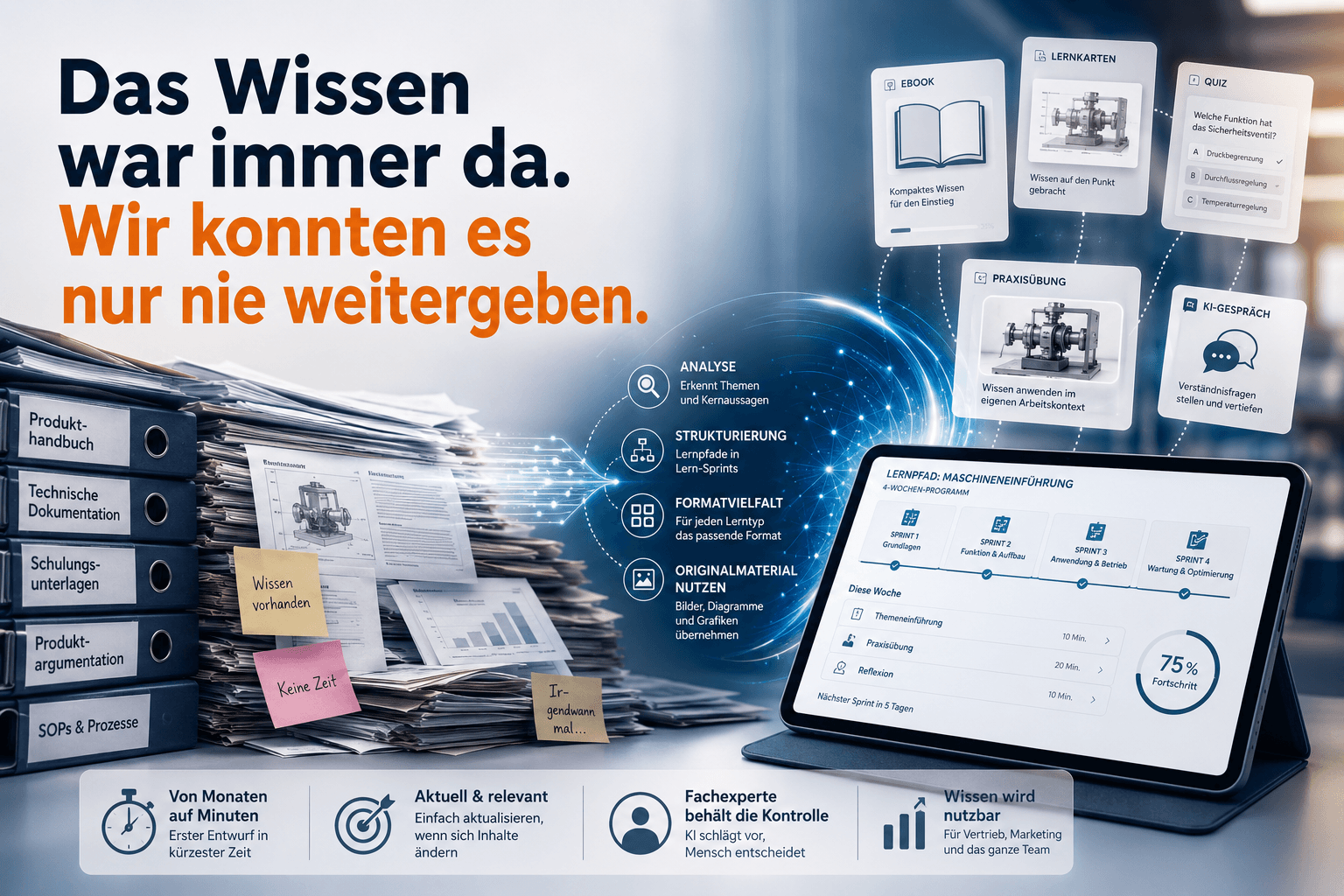
I know this problem from over 15 years of product management in industry. Every time we had a new product, an advancement, or a new line of argumentation, we had to bring this knowledge to sales, marketing, and the rest of the company.
We had the documents. We had the knowledge. But turning it into a form that employees truly understand and can use? There was never enough time for that.
The Problem Everyone Knows
Sales needs good arguments with the customer. They have to understand how a product works, which problem it solves, and why it is better than the alternative. Internally, all employees must know the products, be able to explain them, and present them externally. From the product management perspective, this is crucial.
But how do you convey the knowledge?
In practice, it mostly looked like this: a few meetings per year where we presented news and developments. Along with documents we distributed. Product descriptions, technical datasheets, training materials, argumentation aids. All neatly written, all factually correct.
And then we hoped people would read it.
Of course, organized further training would have been better. A structured learning path where employees absorb, apply, and solidify the knowledge step by step. But that would have meant turning our documents into professional learning media. And that can get very expensive, depending on which provider you hire. And by the time the course was finally completed, the content was probably already outdated.
So it stayed with the documents and the meetings.
Not an Isolated Case
What I know from product management is the norm. Not the exception.
80 to 90 percent of all company data exists in unstructured form. These are PDFs, presentations, manuals, work instructions, training documents, internal wikis. According to Gartner and IDC, this mountain grows three times faster than structured data.
At the same time, creating e-learning takes a lot of time and money. Even with modern authoring tools, the bottleneck remains the same: a person must analyze the content, prepare it didactically, translate it into learning objectives, and create exercises. That takes time.
75 percent of medium-sized companies in Germany use digital further education. But over 60 percent of these are ad-hoc measures, not strategic competence development. The Bitkom study 2025 confirms what many know from everyday life: it's not a lack of willingness. It’s lack of time and resources to convert existing knowledge into usable learning formats.
Companies do not have a content shortage. They have a format problem.
What Is Possible Today
We can do this differently now.
At Fraunhofer IAO on Future Skills Day and at Fraunhofer FOKUS during the 2nd Learning Technology Symposium, we discussed exactly this question with companies: How does one turn documents that have been lying in folders for years into training that actually works?
The answer lies in the combination of AI and the content that already exists.
Thorough analysis instead of full-text search. First, each file is analyzed thoroughly and individually. Whether a 300-page manual, PowerPoint presentation, Word document, work instruction, or short training material. For extensive documents, this happens in several steps: first understanding the overall structure, then deepening chapter by chapter. Short texts are processed directly. From all these sources, a shared knowledge base is created that unites the scattered knowledge for the first time. On this foundation, a structured process builds the actual learning content.
Competence-oriented learning sprints. From this knowledge base, short learning sprints emerge, each focused on a specific competence and related to a real work problem of the learner. Problem-oriented, action-oriented, and personalized to their work context. Each sprint has a thematic introduction, practical exercises matching their own tasks, and a reflection at the end. No one-off course forgotten after three months. And no rigid time specification, but digestible units oriented to actual needs. Behind this is a didactic concept that consistently centers practice.
Not always a full course is needed. Sometimes a short learning sequence of seven minutes is enough, exactly when the question arises at work. How does the quality reporting process work? Instead of searching through the 200-page manual, the employee gets a tailored compact unit: the core answer, the context, a brief practical case, and three comprehension questions. Prepared from the same source material. This is no substitute for the structured learning path but makes knowledge accessible at the moment of need.
Variety of formats. From the same source text, various learning formats arise. A compact e-book for entry, also as a podcast or audiobook. Flashcards for on the go. A quiz for self-assessment. A practical exercise for the workplace. A conversation with an AI agent asking comprehension questions. A simulation for training. Which format is delivered depends on the learning goal and situation, not on an alleged learning style.
Reuse of original material. Texts, images, and diagrams from documents are recognized and integrated into learning materials. The machine diagram from the manual appears again in the flashcard, the photo from training materials becomes part of the practical exercise. And where existing material has gaps, new material can be added specifically or external sources connected.
And the most important thing: the subject matter expert retains control. AI suggests, the human decides. This is not a button push that spits out a finished course. It is an intelligent first draft that a subject matter expert can finalize in minutes instead of months.
What This Means for Companies
AI does not replace instructional designers. But AI makes the preparation of expert knowledge possible for every company under economic conditions.
The manual for machine commissioning, combined with suitable presentations and work instructions? Becomes competence-oriented learning sprints with practical exercises that new employees can work through on their phones exactly when they need the respective competence. The 50 SOPs for quality assurance? Become learning sprints with podcasts, quizzes, and reflection talks that update when the SOPs change. And where it makes sense, sprints can be bundled into a continuous learning path. As needed.
The knowledge lying in folders and on network drives finally becomes usable in the work process. Not sometime, when a budget for an e-learning program is available. But now, from the material that already exists.
And in the end, not only companies benefit. Employees receive competence-oriented learning sprints that start from their concrete work challenges and fit into the workday. With a practical project that is not a constructed example but their real problem. And when they need a quick answer in daily work, they get a short, didactically prepared learning unit instead of a document link. They don’t learn in advance but exactly what they currently need to improve.
In my last post, I described why rigid courses no longer work and what dynamic learning paths can look like. This post closes the loop: whether continuous learning path or competence-oriented learning sprint, both need content. And the content in most companies is already there.
It was just in the wrong format.