Workplace Learning – next Generation
Self-organized learning within the work process, with VIA and human learning partners, closes the gap between diagnostics and effective competency development — scalable for all employees, not just the top 50. The platform is live; we're opening the 2026 starter offer to companies that want to help us build it out.
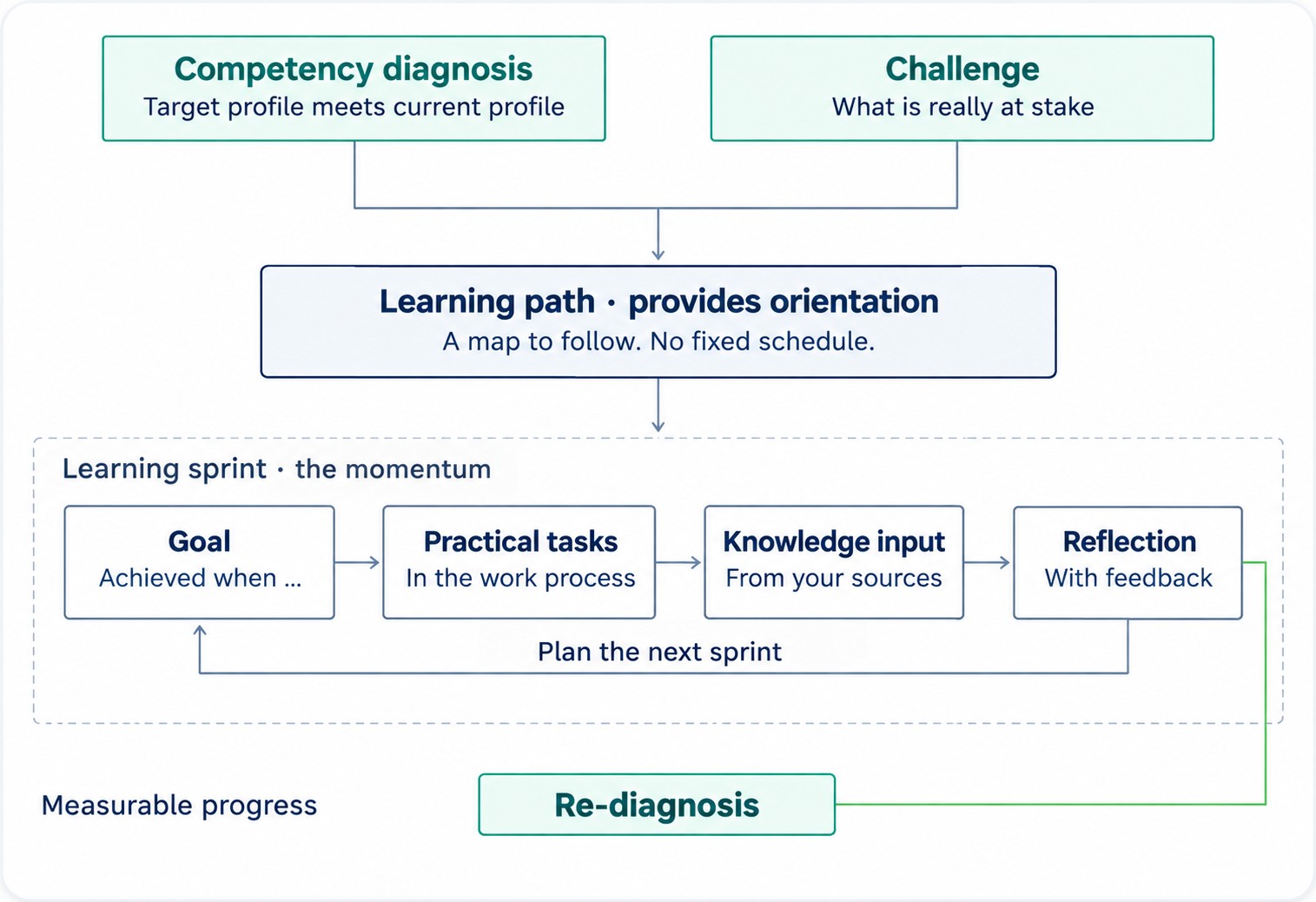
Around 90% of training knowledge evaporates
Many classic courses have been digitized, but they still follow a fixed schedule that's the same for everyone. Even blended learning merely combines different learning formats without fundamentally changing this rigid structure.
Content is the same for everyone
Regardless of competency profile, practical context, prior knowledge, experience or maturity — all participants learn the same content according to a curriculum.
A shared pace is imposed
Unit 1 in week 1, unit 2 in week 2. Even if some learners have long since mastered the topic, others struggle to understand it, or another question would be more pressing.
Reflection happens outside of work
The engagement takes place within the course — not in the concrete work situation where the competency actually becomes effective.
The question isn't whether the course as a format is dying. The question is: which learning architecture develops competencies effectively within the work process — and where is the course a deliberately chosen element within it?
Skills management used to end mostly at diagnostics
Values and competency models are the right basis for solving the transfer problem. But in practice, the impact was far too often lost, because formal learning offerings such as training, e-learning or videos don't enable competency development.
Diagnostics without a follow-up
Skills diagnosis, maybe a seminar recommendation — and then? The results end up in a drawer. What was missing was the tool that turns the diagnosis into actual competency development within the practical work process.
Accessible only to a few
Skills and values management used to be exclusive talent management — reserved for young talent and high potentials. Not at scale.
Specialist knowledge as a bottleneck
It took experienced skills and competency managers to guide employees individually. Great when available — but not scalable.
With ValCom Learning, we finally make skills management accessible to everyone. Not just the top 50, but all employees. Not dependent on individual specialists, but supported by AI within a didactic concept. And with a clear focus on soft skills — the values and competencies that matter more and more in an AI-shaped world of work.
AI alone doesn't make a learning path
AI can generate content. Learning only emerges once that content is embedded in a didactic concept: with clear competency goals, a real practical task, VIA as a learning partner, and exchange with other people.
Foundation
A values and competency model, proven learning methods and diagnostics give the learning path structure — instead of letting AI interpret freely.
Practical project + VIA
The practical project is the common thread. VIA provides knowledge, answers questions, simulates conversations and supports implementation within the work process.
Community
Learning circles, tandems, mentoring and peer reflection bring perspective, trust and critical sparring — no AI replaces that.
Other platforms ask: "How do we generate content with AI faster, more beautifully and more cheaply?"
ValCom Learning asks: "How do we make sure people actually develop competencies — at work, with real impact?"
Even a course can be personalized
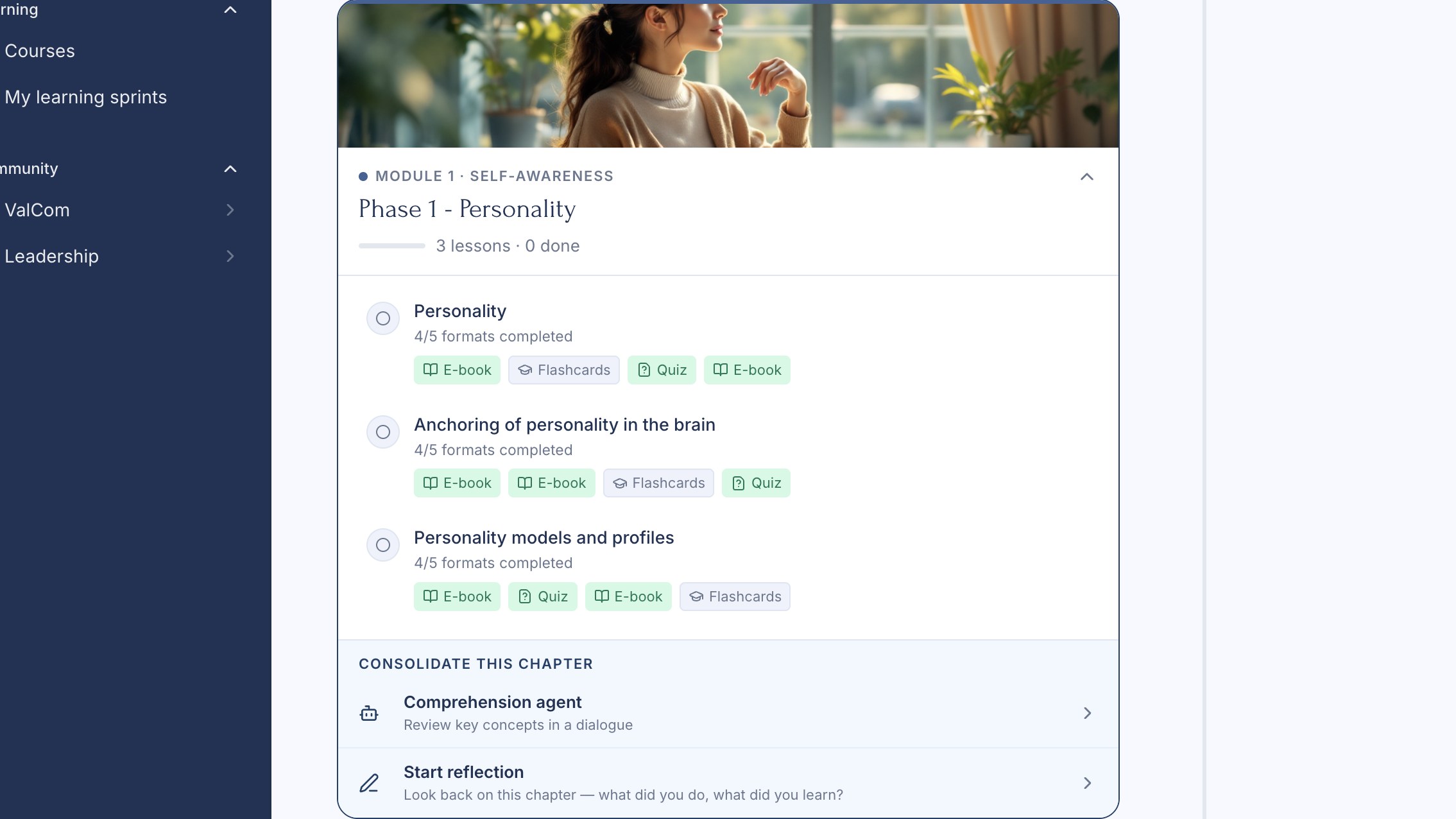
Before we generate the learning path in a fully dynamic way, our Leadership course shows that even an existing course structure can be radically personalized — without losing its content framework.
- Practical task at the core of every module. The focus isn't the theory input, but a concrete practical task — oriented on current challenges at work.
- Multi-format content by learning preference. AI generates podcasts, explainer videos, mind maps, quizzes, flashcards. The content stays the same, the learning formats adapt.
- Self-learning and blended flow seamlessly. Self-organized at your own pace, in a learning group with experienced learning facilitators, or with a learning partner — your choice.
Showcase
Leadership course. 13 weeks, modular, personalized. Practical tasks as the common thread, multi-format content, optional learning group or self-learning. Already in use today.
From curriculum to dynamic learning path
The learning process changes completely. At the center is no longer the knowledge module, but the practical project. Knowledge modules, flashcards, explainer videos and mind maps still exist — but as a supplement, not as the learning path itself.
Deep onboarding
Before we generate a learning path, the AI gets to know the learner: what knowledge and experience do they bring, what does their values and competency profile look like, how do they prefer to learn, what preferences do they have, what are their goals, what motivates them?
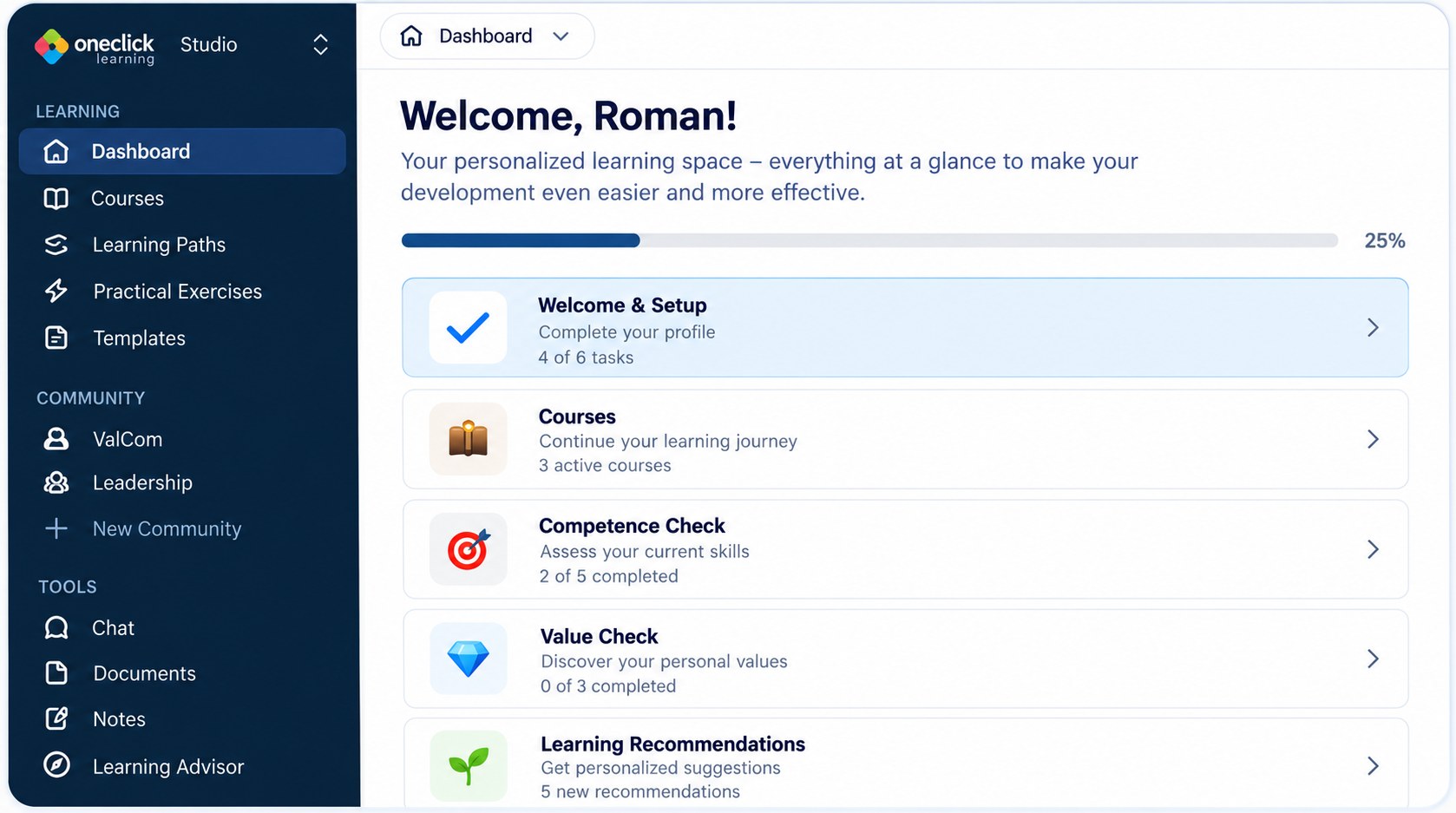
Baseline assessment
From the job profile, we derive the matching values and competency profile as well as the relevant hard skills with AI support. The 360° feedback builds on this — self-assessment, external assessments by the manager, colleagues and learning partners.
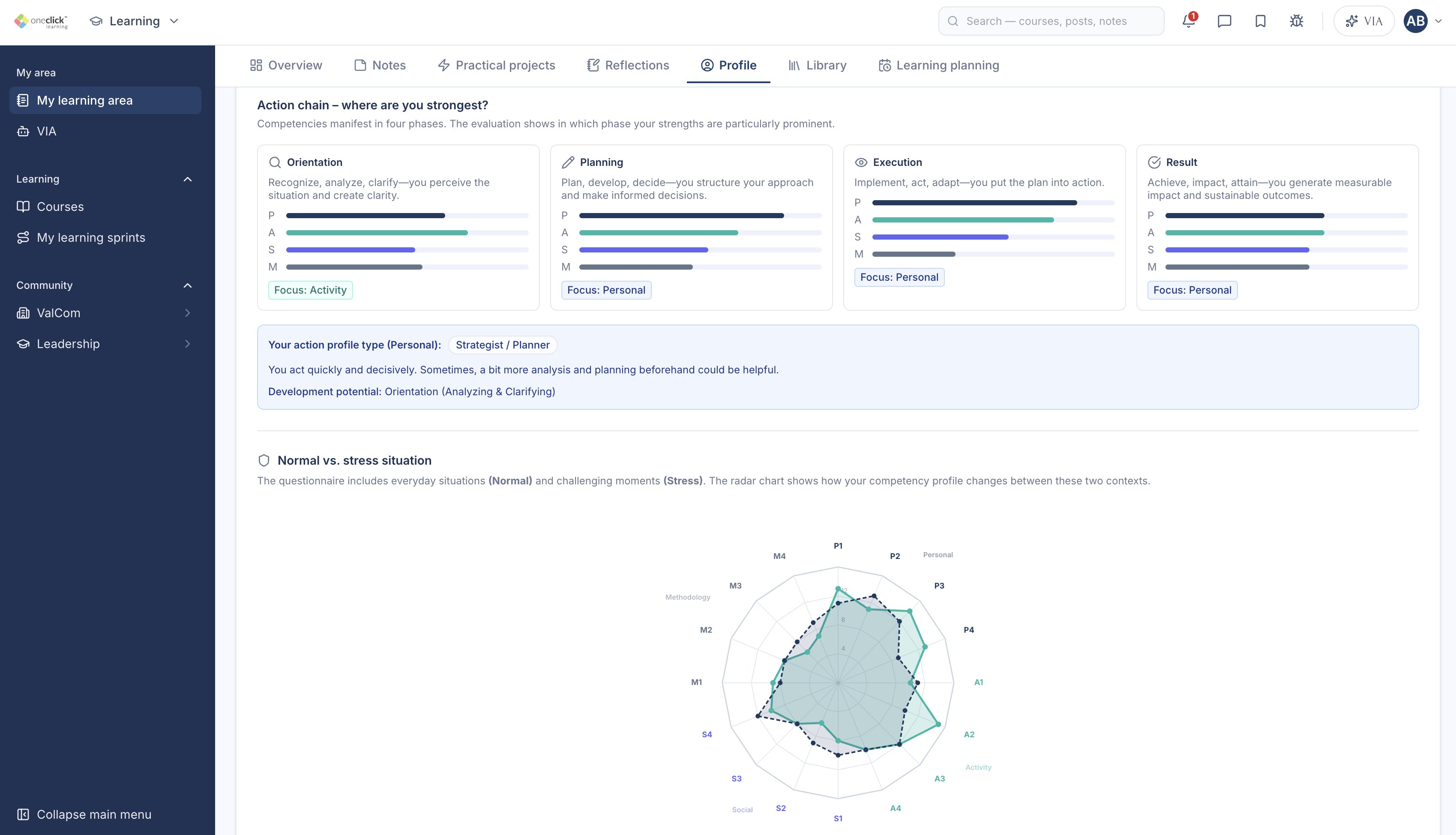
Practical project at the center
A real challenge from your everyday work that requires learning and needs to be solved over the coming weeks. We only use training or further education where it's needed as a basis.
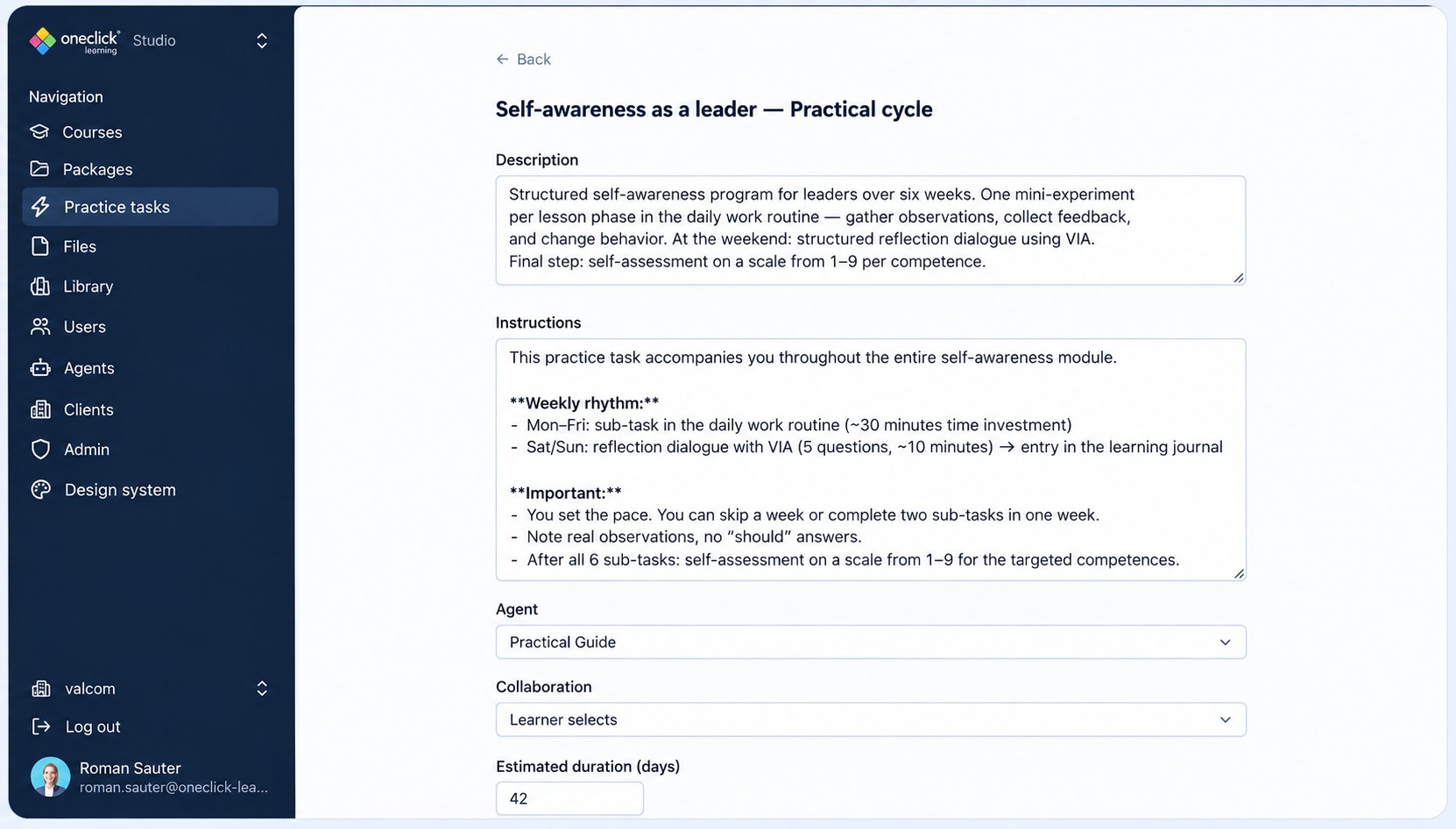
Your own sources
You upload your own, even unstructured documents or connect external sources — internal concepts, specialist literature, industry studies. On this basis, the platform generates a personalized learning path.
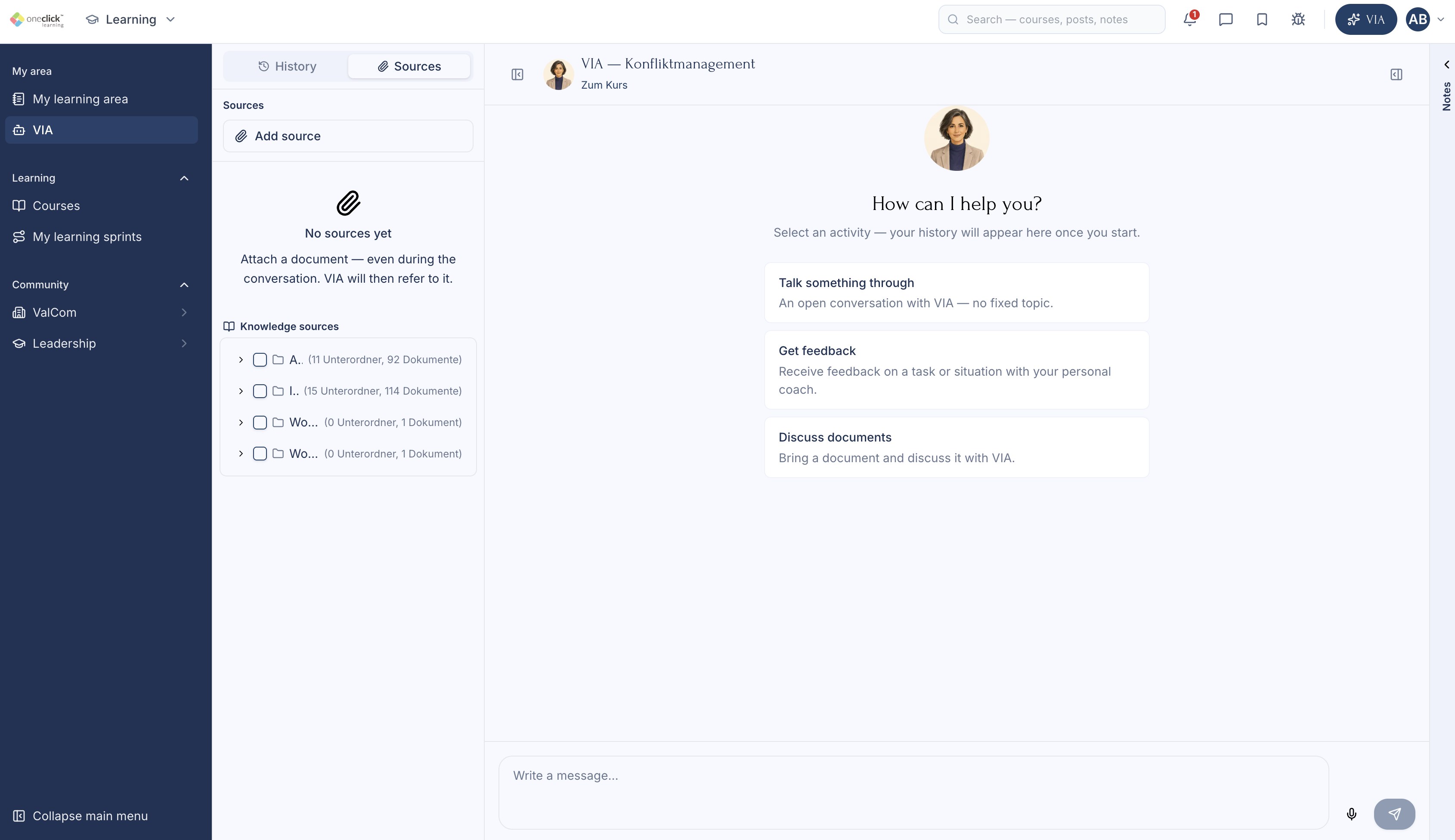
AI generation with didactics
From unstructured sources come explainer videos, podcasts, flashcards, mind maps, quizzes and summaries — embedded in didactically meaningful learning steps.
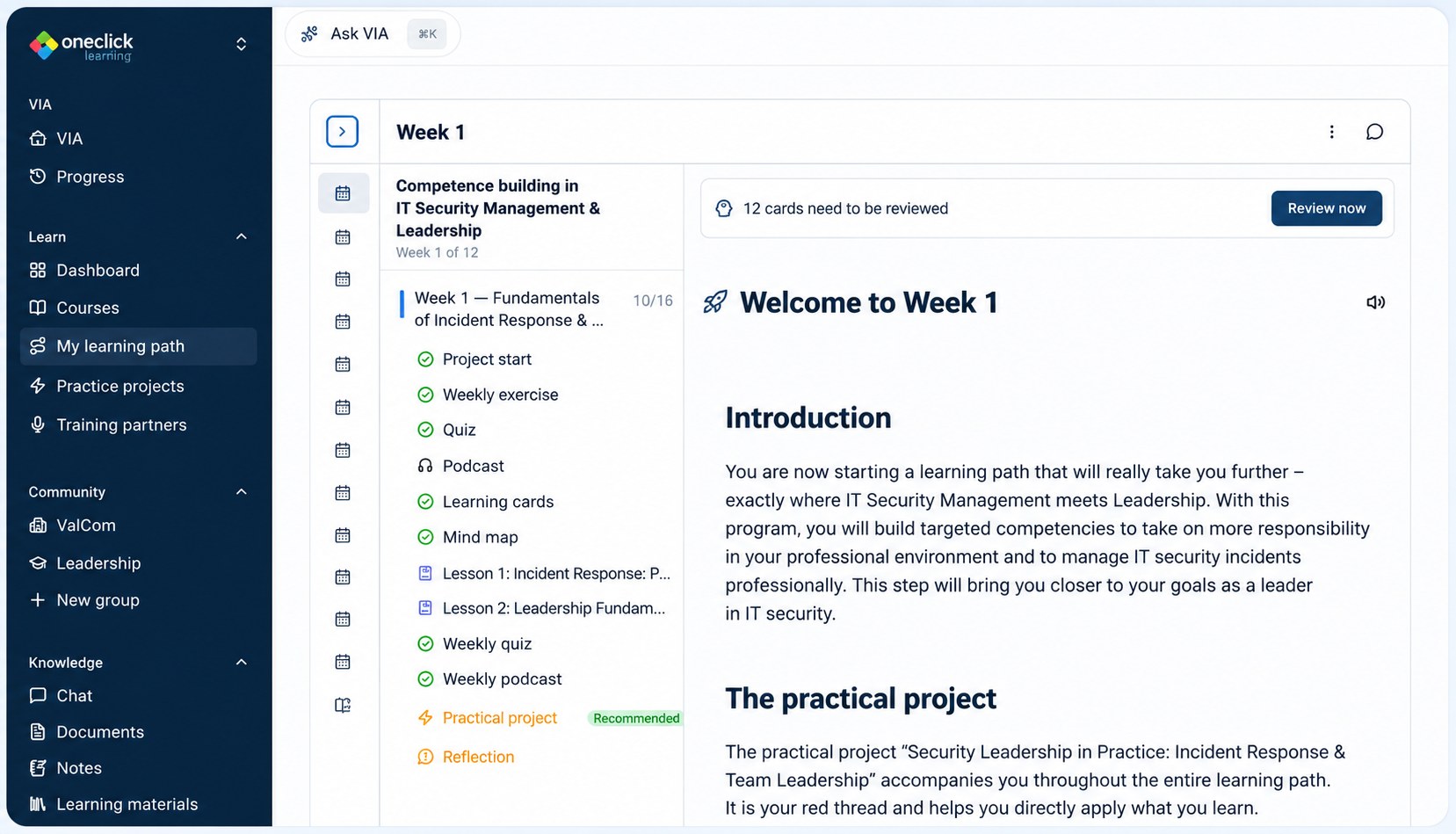
VIA and its AI agents
Conversation simulator (role play), subject-matter advisor (source-based), planning agent (calendar integration), content generator. From the learner's perspective: one companion with different modes.
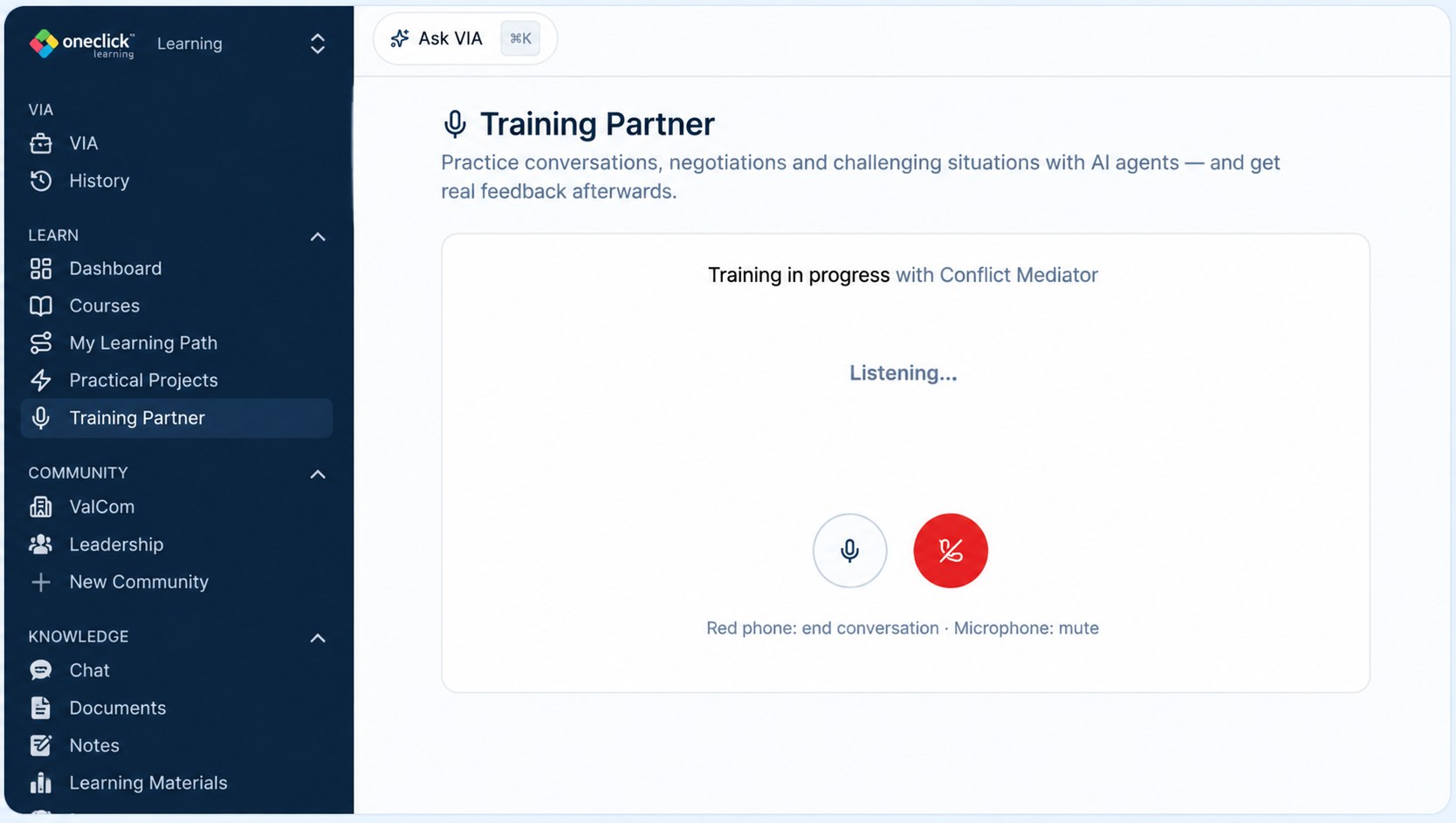
Reflection loop after every sprint
What did you try out in practice? What worked, what didn't? A learning sprint takes one to two weeks depending on the learner; afterwards comes the reflection, which forms the basis for regenerating the next sprint. Data-driven, in the rhythm of work.
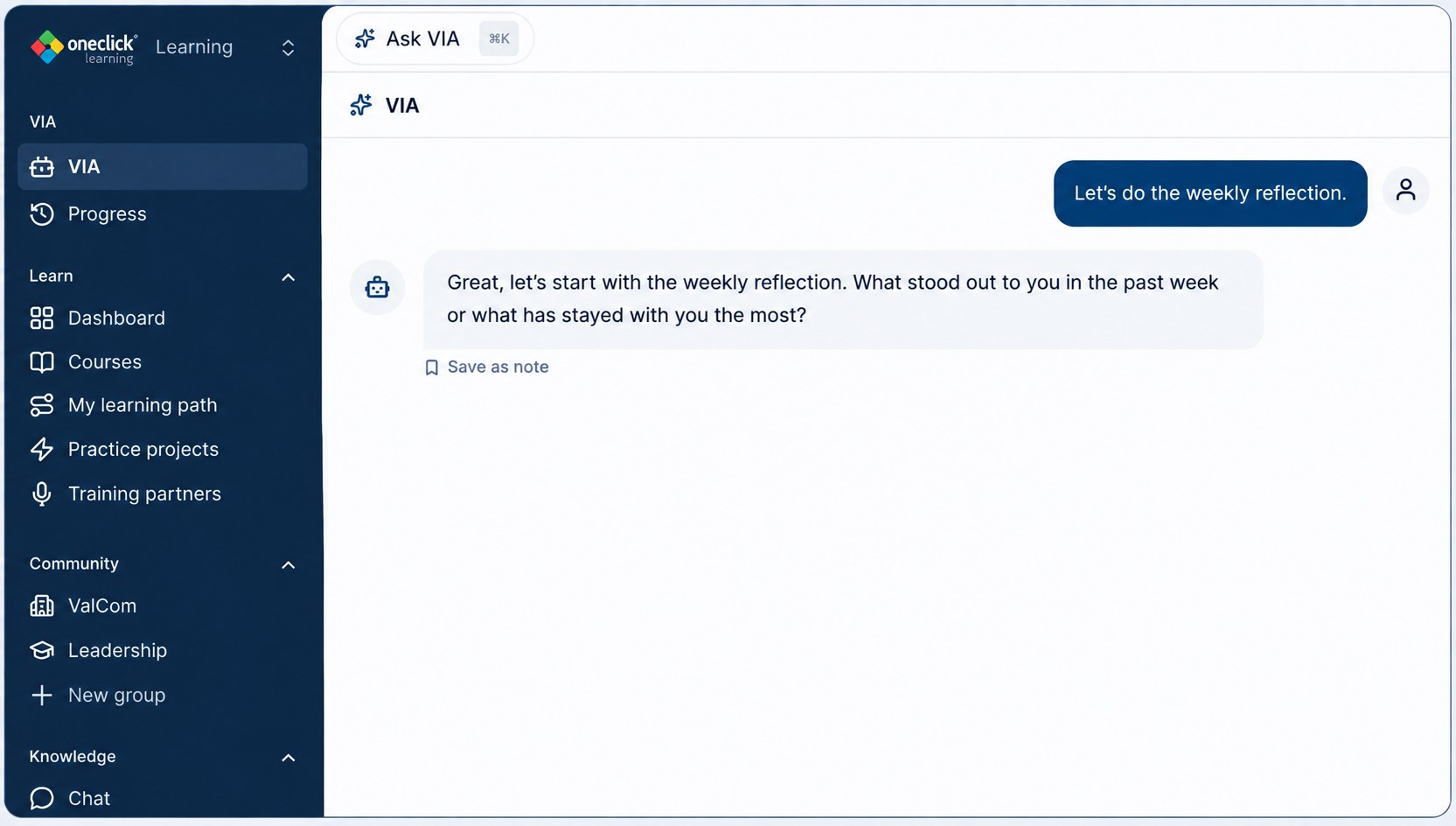
Under one roof, ValCom Learning combines hybrid search, long-term memory, curated work methods and multi-agent orchestration. The result isn't a monolithic chat, but a GDPR-compliant learning partner that brings together sources, context and didactic building blocks.
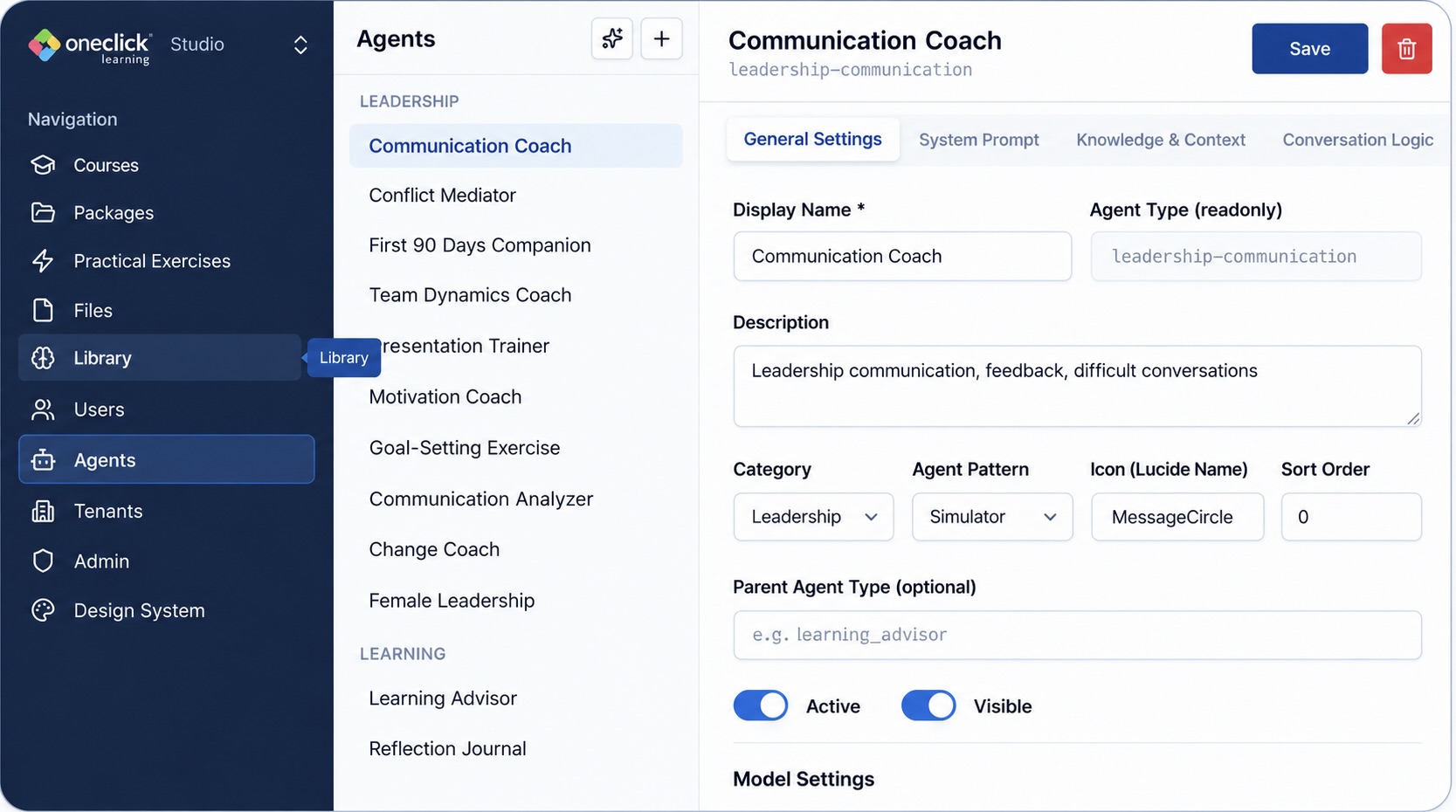
Whoever designs learning content works in Studio
ValCom Studio is the admin view of the same platform — built for L&D professionals, learning facilitators and trainers who configure values and competency models, courses, practical projects and learning paths.
- • Create values and competency models, derive them from job profiles with AI support
- • Integrate courses, modules, practical projects and your own sources
- • Create and configure your own AI agents — coaches, simulators, advisors
- • Integrate internal company content into the RAG and graph database
- • Review and curate learning paths — approve or adjust AI suggestions
- • Configure VIA: tone, sources, role plays, reflection questions
- • xAPI / SCORM export, integration with existing LMS platforms
- • User, role and tenant management, reporting
Studio is part of ValCom Learning — not a separate product. There's one platform; learners and learning managers see different views depending on their role.
We don't stop at the individual learning path
Skills management isn't just a topic for employees, but for the organization too. ValCom Skills Mapping will build on the three modules of the suite going forward.
What's already there
- • Job profile → competency profile: AI-supported derivation of individual learning goals and personalized learning paths within the work process, in dialogue with the AI learning partner
- • Market monitoring: job crawler observes job postings, maps them against the ValCom taxonomy
- • Early heatmap approaches: making skills concentration and gaps visible
Where we want to go (outlook, 2027 starter offer)
- • Keeping competency models current: AI suggestions when the market shifts
- • Strategic heatmaps: where does the organization have competencies, where are the gaps to strategy?
- • Skills mapping for employees: which role or function fits my profile?
Skills Mapping is in development. Starter-offer partners for ValCom Learning get insight into the roadmap and can help shape the requirements for Skills Mapping.
More impact. Lower cost
Learning Guild 2025 calculation
up to 2/3
lower training costs
AI-supported learning doesn't just save budget. It shifts learning into practice, reduces bottlenecks and makes competency development accessible to far more employees.
Content creation
ClassicExpensive, slow, staff-intensive
ValCom LearningAI-generated on demand and didactically embedded
Trainers
ClassicHigh cost and bottleneck factor
ValCom LearningLearning facilitators complement the AI where needed
Rooms and travel
ClassicSignificant organizational effort
ValCom LearningLargely eliminated through learning within the flow of work
Time away from the job
ClassicHigh opportunity cost
ValCom LearningLearning happens in the work process
1:1 coaching
ClassicEffective, but hardly scalable
ValCom LearningAI coaching for everyone, complemented by mentors
Cultural value
Self-organization isn't just taught, but practiced every day. Soft skills are developed systematically — not by chance.
Economic value
ValCom Learning scales competency development, reduces training costs and increases effectiveness through direct application.