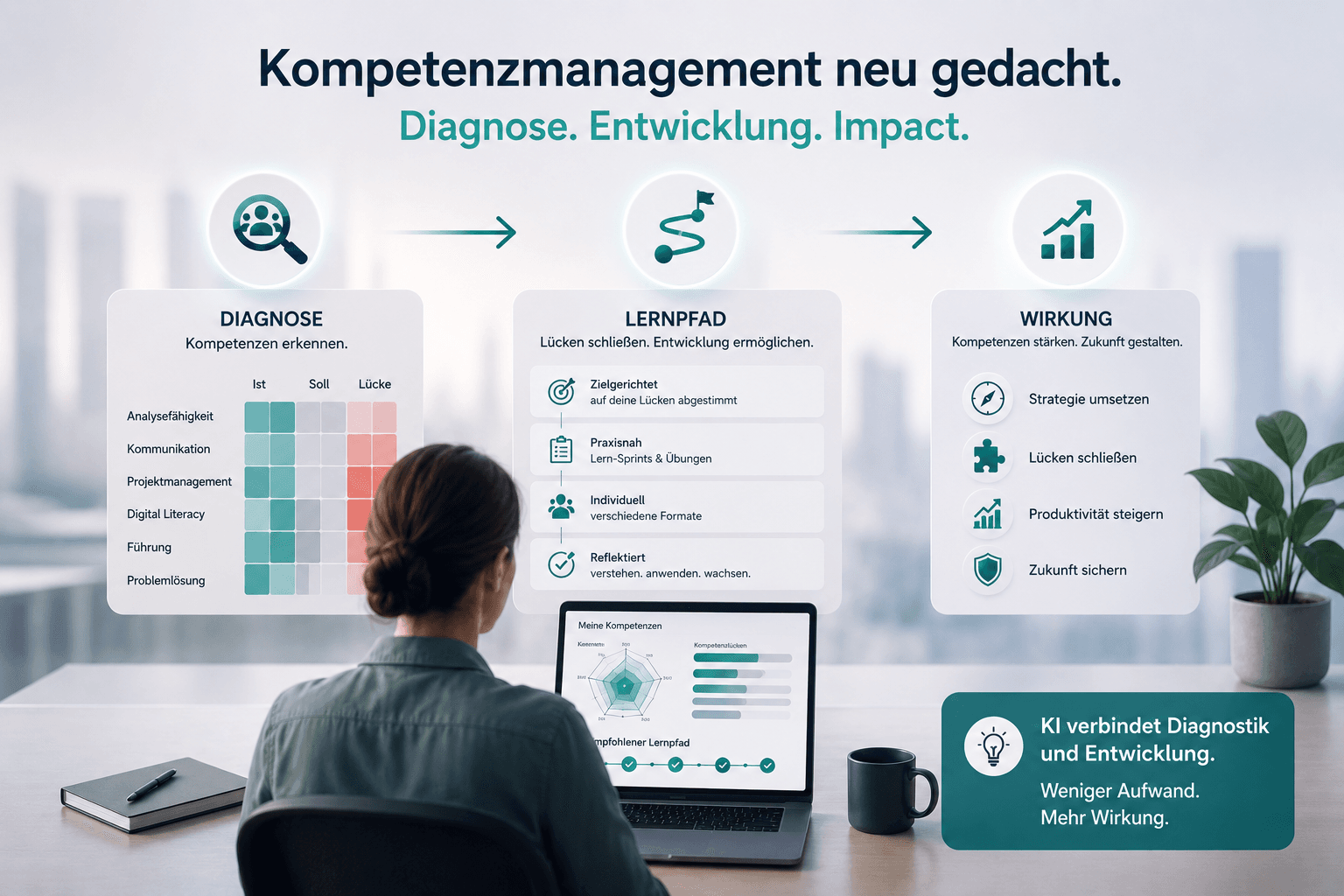
Competency management is one of those ideas that no one can argue against. Of course, a company should know which competencies its employees have. Of course, there should be a plan to close gaps. Of course, the whole thing should be strategically anchored.
In theory, everyone agrees. In practice, however, it fails in most companies.
Why It Fails
I have been having conversations with HR managers, L&D teams, and executives about competency management for over ten years. In sales, consultation talks, and customer projects. The criticisms repeat.
Creating competency models is time-consuming. A usable competency model for an organization with ten roles requires a lot of time. Often with external consulting, because internally there is neither the time nor the methodology. In the end, there is a document with role expectations and competency levels that is well received when presented.
Then the real problem begins. The model must be transferred into a tool. Employees have to accept and use it. Managers must build development discussions on it. The HR team must maintain, analyze, and keep the data up to date. And as soon as roles change or new ones are added, the model must be adjusted.
And then there's the time factor. In today's working world, competency models change incredibly fast. Core competencies may be more stable with soft skills, but descriptions and requirements shift. With hard skills, the pressure is even greater. Technologies, tools, and methods develop so quickly that a competency model often already has gaps when it's introduced.
The reality: In most companies, exactly that does not happen. The competency model is created once and then barely maintained. The data becomes outdated. Employee acceptance decreases because they see no direct benefit. Eventually, it is just a document lying in a SharePoint repository.
And because it was all so time-consuming, competency management in many companies has been reduced to talent management. Instead of developing the entire workforce, focus is on top talents, the leadership pipeline, high potentials. Understandable, because resources are limited. But it means that the broad mass of employees is excluded from systematic competency development.
The Numbers Confirm This
According to a kybernet analysis, only 9.6 percent of German companies systematically record and develop competencies. Not 50 percent. Not 30. Under ten.
The Workday study "Global State of Skills 2025" shows: Only 43 percent of German managers have a clear overview of competencies in their workforce. More than half fly blind.
And while the World Economic Forum finds that 60 percent of companies see qualification deficits as the biggest obstacle to change, only 19 percent of respondents say closing these gaps is among their employer's top priorities.
Competency management does not fail due to the idea. It fails due to implementation. Too complex, too laborious, too little benefit for the individual employee.
What Is Changing Now
The problem was never that companies did not want to manage their competencies. The problem was that the effort was disproportionate to the result. Lengthy modeling for static reporting that ends with development recommendations nobody implements.
AI fundamentally changes this equation. And in two places at once.
First: skill diagnostics become scalable. Creating and maintaining competency profiles for individual roles manually was previously extremely time-consuming. AI drastically reduces the modeling effort. Not as a replacement for professional classification, but as an intelligent first draft that an expert can quickly validate. Competency models can be automatically matched against a scientifically based taxonomy, instead of starting from scratch every time.
Second, and this is the crucial step: It doesn't stop at reporting. This is the point where most competency management solutions end. They provide diagnostics, a dashboard, a report with gaps and recommendations. And then? Then someone has to manually build real further training from these recommendations. Expensive. Slow.
What If Diagnostics Directly Led to a Learning Path?
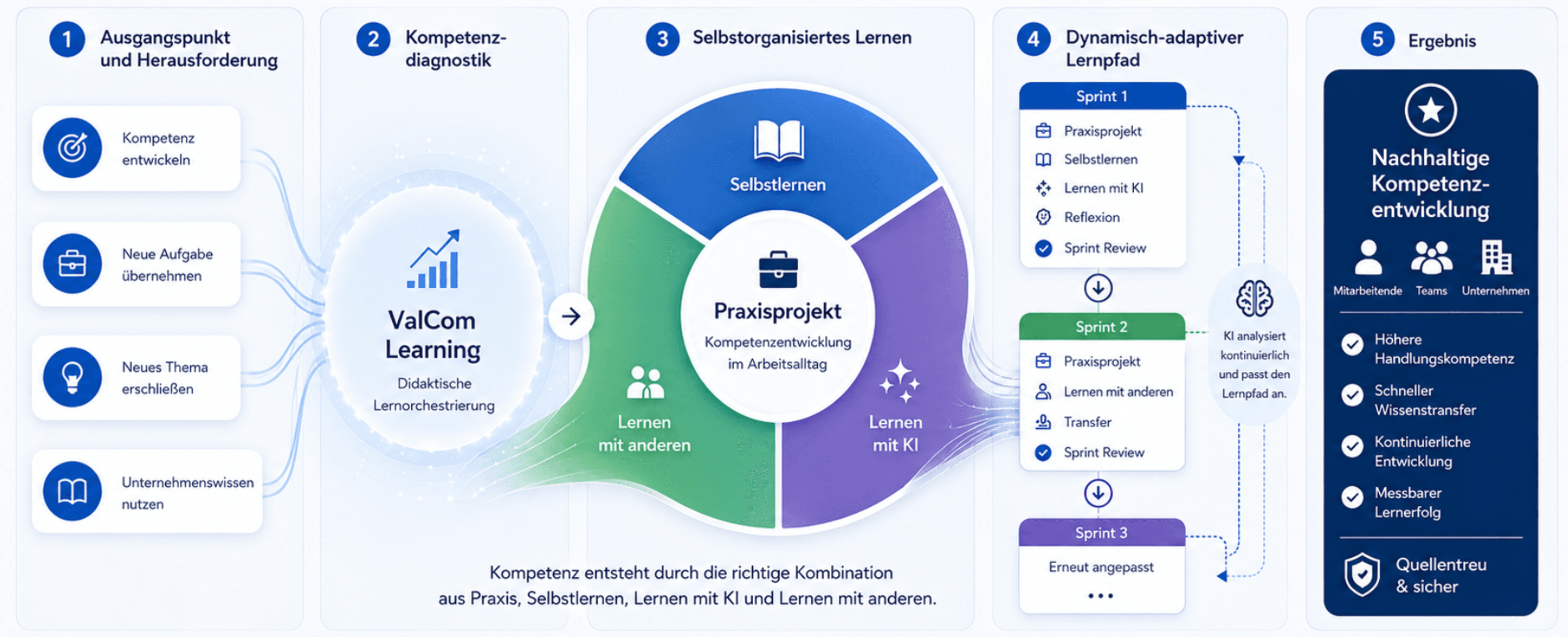
Not a generic course recommendation from a catalog. But a personalized, adaptive learning path tailored to individual competency gaps. Structured in learning sprints. With practical exercises that fit the employee's own work context. With various learning formats, because not everyone learns the same way. With reflection and comprehension checks so that not only consumption but actual learning takes place.
And hard skills are always included. Knowledge is a prerequisite for developing competency. That’s why we always consider technical knowledge in diagnostics and learning path creation, not just soft skills. Hard skills greatly influence how a learning path is structured and which content is relevant.
The crucial point: competency management belongs in the hands of managers and employees. Not as an annual HR project rolled out top-down. But as a tool managers can use directly to develop their team. And ultimately as a tool employees take into their own hands to steer their own development.
The competency model becomes alive. It is no longer a static document retrieved once a year in a development discussion. It is the foundation for continuous, personalized competency development.
What This Means for Companies
Competency management does not have to be complicated. It was complicated because there was a gap between diagnostics and development that could only be closed with a lot of manual effort.
AI closes this gap. Not someday. Now.
A company can define its roles and competencies, diagnose employees, and directly generate individual learning paths from that. Without lengthy modeling. Without a six-figure consulting budget. Without reporting that ends up in a drawer.
And that also changes the strategic role of competency management. It is no longer just an HR instrument that documents personnel development. It becomes a control instrument for management: What competencies does the organization have? Where are critical gaps emerging? How quickly can the workforce react to new requirements? These questions can suddenly be answered data-based, in real time, not once a year.
A company can define its roles and competencies, diagnose employees, and directly generate individual learning paths from that. With significantly less modeling effort. Without having to start from scratch each time. Without months of consulting projects before the first learning path is created. Without reporting that ends up in a drawer.
The competency model delivers the target image. Diagnostics show the gaps. The learning path closes them. Competency management that does not stop at reporting but begins at learning.