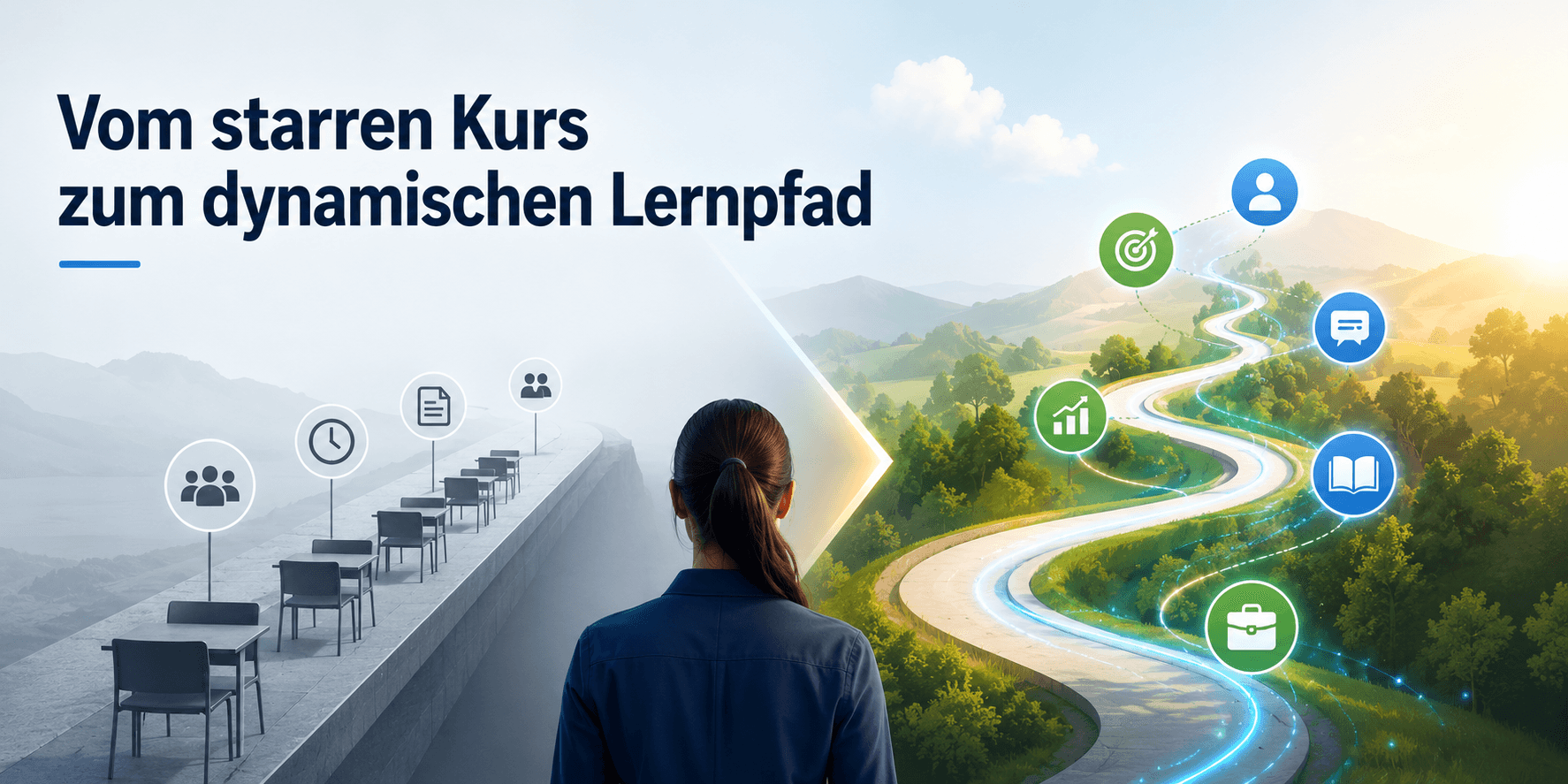
At ValCom, we are reimagining courses. Not because the course format has become obsolete, but because in most cases its structure pays too little attention to the individual learner. Content is the same for everyone, fixed pace, reflection within the course framework instead of in the work situation where the competence is actually needed. We design courses that align with the learner, not the other way around. And this happens in two stages that we are currently working on consistently.
The question of what courses should look like in the future currently occupies the entire industry. Christoph Meier recently published an article on LinkedIn on this topic, which we received very positively. We see it similarly, and that is exactly why we are actively working on this subject. Our answer is not theoretical but embodied in the platform we are currently building.
Stage 1: Personalizing Existing Courses
In our leadership course, we show that a modular course can be personalized without losing its core content structure. Roughly speaking, there is a predefined learning logic. Module 1 is self-awareness, Module 2 communication, Module 3 presentation, and so on. But exactly these modules are broken down within the course structure.
Knowing the learner before delivering content. Even in a structured course, we assume we get to know the user well. Learning preferences, prior experiences, current practical challenges. Based on this, we individually deliver content — even within a fixed module sequence.
Practical task as the core of each module. The focus is not on theoretical input but on a concrete practical task. This task is aligned with your current work challenges, not a standard scenario from a textbook. This places learning where it matters: in the workplace.
Multi-format content according to learning preference. Want the module read to you? Then you listen to the generated podcast. Prefer visual learning? Then watch the video. Want to test your understanding? Then take the quiz. Content remains the same; the form adapts.
Self-learning or blended learning, the standard is the same. Those who want to work through alone start when it fits, self-organized, at their own pace. Those who want to learn in a group join experienced trainers and peer reflection. Those seeking a learning partner can do that too. Both formats are equally personalized. The difference lies in the form of guidance, not in the level of individualization.
This is the first stage: existing course structure, but personalized content, formats, and support. Personalized course instead of mass-produced content.
Stage 2: Generating Learning Paths Completely Dynamically
The second stage goes further. Here, there is no predefined module structure anymore. Instead, the learning path forms freely and dynamically, individually for each learner. That is exactly what we are consistently implementing on a proprietary learning platform based on ValCom. The next logical step after diagnosis.
Status Assessment: Job Profiles, Competencies, 360-Degree Feedback
Before developing dynamically, you have to know your current status. We start with the job profile. With AI support, we derive the appropriate value and competency model as well as the relevant hard skills from the profile. What must this role truly be able to do?
On this builds the 360-degree feedback. Self-assessment, supervisors, colleagues, and learning partners. From this, a clear picture emerges: Where do you stand, what are your strengths, where is the greatest potential for development?
Deep Onboarding: Getting to Know You, Not Just Your Skills
Diagnosis alone is not enough. Before generating a learning path, we get to know you as a learner. How do you like to learn, what preferences do you have, what are your goals, what motivates you? These questions are not soft. They decide whether a learning path fits you or bypasses you.
Practical Project at the Center, Knowledge Modules as Extras
Here the logic shifts completely. The center is no longer a knowledge module you complete. At the center is the practical project. A real challenge from your workday that you solve over the next few weeks.
Example: You work in sales and identify communication difficulties as your development need. Then you practice exactly this skill where it matters: in real customer conversations. Beforehand, you can get targeted theory to prepare. But the real exercise is the conversation itself, not the module before it.
Knowledge modules, explanatory videos, flashcards, quizzes, mind maps—these all continue to exist. But as additional offerings, not the main path. Those who need theory get it. Those who want to go straight into practice, do so.
Own Sources, Dynamic Generation
You choose a topic that interests you or one identified as a skill gap by diagnosis. You upload your own documents or connect external sources: internal concepts, specialist literature, industry studies. Based on this, the platform generates your learning path. Practical project, fitting exercises, complementary knowledge modules, learning methods that match the competence and your learning style.
Behind this is a knowledge architecture we deliberately built: a retrieval-augmented generation (RAG) system based on a graph database, combined with large language models, long-term memory per learner, and an extensive database of work methods. This allows the learning path not only to be dynamically generated but also learned and adapted over time.
AI Agents as Specialized Companions
Where in classic courses trainers and coaches take on individual tasks, we deploy specialized AI agents. One simulates conversations, e.g., the sales pitch before a real customer meeting or the difficult employee discussion before the real situation. Another advises on technical questions based on your sources. A third is your planning agent. It has access to your calendar and plans week by week together with you when which exercise fits your work rhythm.
The Weekly Reflection Loop
What truly makes the learning path dynamic is the weekly reflection with AI.
Every week a short reflection dialogue: What did you try out in practice? What worked, what didn't? Where were the real difficulties? Based on this reflection and what you actually implemented, the upcoming week is generated. Unlike a classic course plan, the learning path adapts to you. Week by week, data-driven, in your work rhythm.
This is enabling didactics in practice: no predefined curriculum you complete, but accompanied development oriented around real progress.
The AI Learning Partner, Alongside Real Learning Partners
Throughout all weeks, the AI learning partner is at your side. Not as a replacement for human learning partners, trainers, or mentors, but as additional support that is always available and knows your context.
This scales what a very good mentor ideally would deliver to 50, 200, or 2000 employees.
Dynamically Generated Does Not Mean Arbitrary
Here lies the decisive point for us. Many tools now generate learning content at the push of a button. Content generation has become easy. But generated content is not learning yet. What arises dynamically at ValCom happens within a clear didactic framework. Learning theory is not decoration but the logic by which every learning path is constructed.
Three examples without going too deep into theory:
Every learning objective gets the appropriate form. We work with the revised Bloom’s taxonomy (Anderson and Krathwohl). It distinguishes whether it’s about facts, concepts, procedures, or reflection of one’s own actions, and on what level (understand, apply, evaluate, create). From this, we derive the form. Factual knowledge is learned differently than an attitude. The platform therefore doesn’t just deliver the same e-book for everything but chooses the format and method matching the learning objective.
The guidance follows a didactic logic. The AI learning partner shows more at the start, gives examples and support. With growing competence, it withdraws and demands more independence. The supports intentionally fade, just as a good mentor would.
The practical project remains central; methods are recommendations. Core is development in real work, not knowledge consumption. Suitable learning methods—from peer coaching to Working Out Loud to mentoring—are suggested by the platform aligned to competence, current level, and situation. A suggestion, not a prescription.
This ensures dynamic generation is not a matter of chance. AI delivers speed and personalization; the didactic framework ensures that real competence develops at the end.
Our Thesis and What We Do About It
We are convinced: value and competency models are the right basis to solve the transfer problem in competency development. Not because they depict a theoretical ideal, but because they enable differentiated diagnosis—and thus a learning path developed precisely to the point. We consistently implement this at ValCom.
When the Course Still Makes Sense
There are situations where conscious removal from the work process is necessary. Deep changes, new roles, taking on leadership, cultural transformations.
Here a course can be exactly the right format. But not as a standard path, rather as a consciously chosen special format embedded in continuous practice of diagnosis, dynamic learning paths, and AI learning partner.
From Standard Format to Special Format
The question is therefore not: Is the course dying? The question is: Which architecture effectively develops competence in the work process, and where is the course a consciously chosen element within it?
Workplace learning, next generation: diagnosis, personalized course, dynamically generated learning path, AI agents, weekly AI reflection, AI learning partner as constant companion. With the classic course as a tool for targeted change steps, not a universal solution.
100% impact instead of 10% transfer rate. No curriculum treating everyone the same. But individual guidance, data-based, at the workplace, measurable. And week by week adapted to your real progress.
Want to see concretely how this looks in your company? How to move from rigid course plans to dynamically generated learning paths with AI reflection and AI learning partner, based on your diagnosis and your sources?
Book a 30-minute demo. We will show you with the example of the leadership course how far personalization has already come today and which step we are taking next with the learning platform.