What someone can do, and what the role requires
The required values, competencies and hard skills become target profiles, assessments and skills gap evaluations – for employees, teams and the organization.
The only module already running in day-to-day operation today.
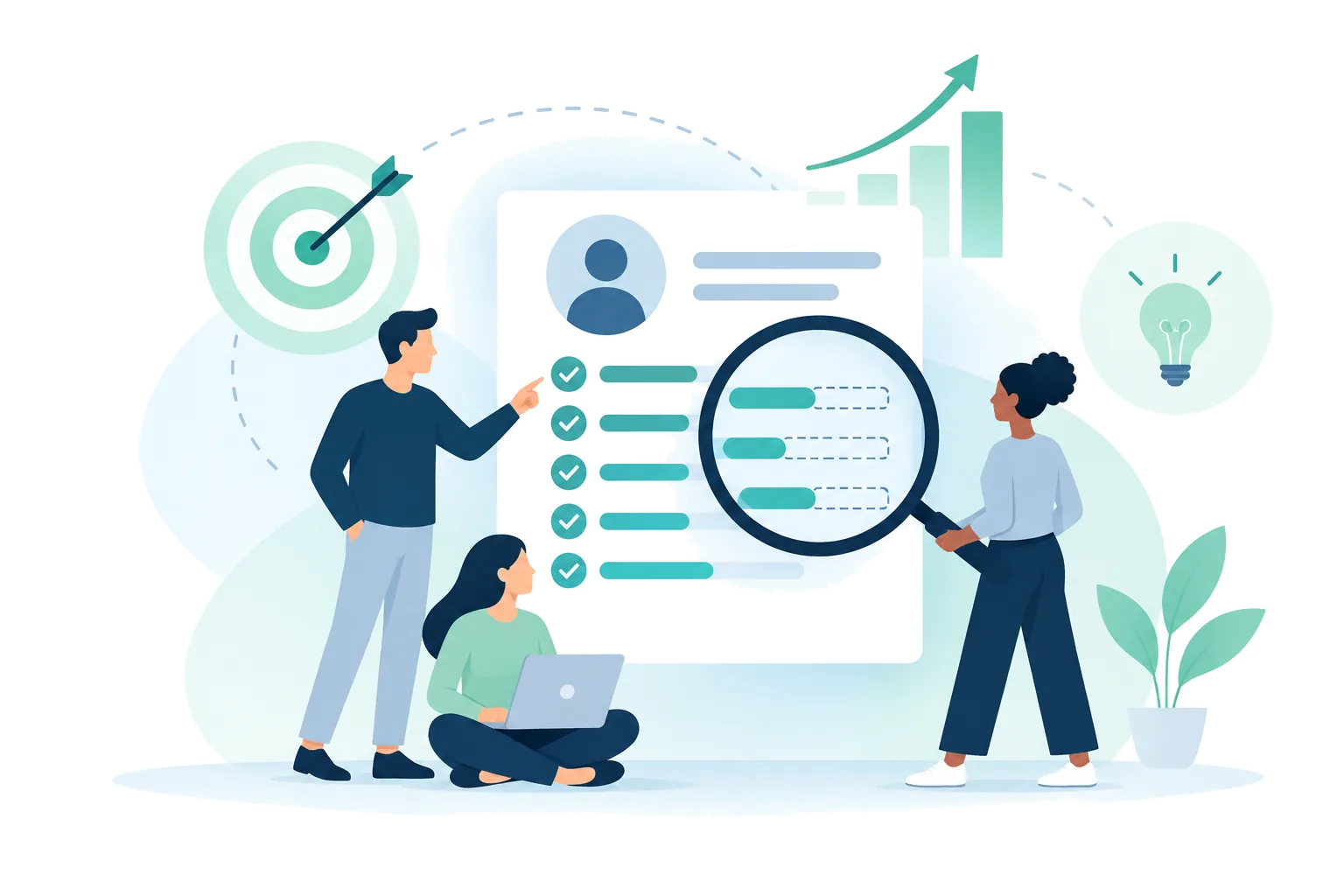
In hours, not months. Building on your proven, existing model
First, we get to know your organization
Industry, culture, roles, requirements. Only this understanding makes the models a precise fit.
The AI builds on your job profiles
You provide your job profiles, and matching values and competency models emerge from them.
Existing models are carried over
Many companies already have their own competency model, often developed with considerable effort. We build on it instead of replacing it.
Diagnosis and skills gaps
Self-assessment, optionally 360° feedback from managers, peers and employees. The result: visible strengths, prioritized development fields.
From target profile to personalized learning path
Target profiles
- From role and job profiles
- Competencies, values and hard skills kept separate
Assessment
- Self- and external assessments
- 360° feedback for tasks, functions and teams
- Behavioral anchors instead of gut feeling
Evaluation
- Target-actual comparison and skills gaps
- AI reports with recommendations
- Individual learning goals and personalized learning paths
Perspectives
- Employees, teams and organization
- Comparable across role clusters
- Development over time
Scientifically grounded models
The basis is the values and competency model by Prof. Dr. John Erpenbeck and Prof. Dr. Werner Sauter, drawn from three decades of joint research and practice. Every competency and every value contains a definition, concrete behavioral anchors or value examples, a description of the exaggerated form, and stored development recommendations.
around 390
competencies and values, scientifically grounded and fully worked out
509
values as an anchor of self-organized action
4 / 16
areas and fields, comparable across tasks and functions
8
hard skills: knowledge, skill, methods, tools, qualifications
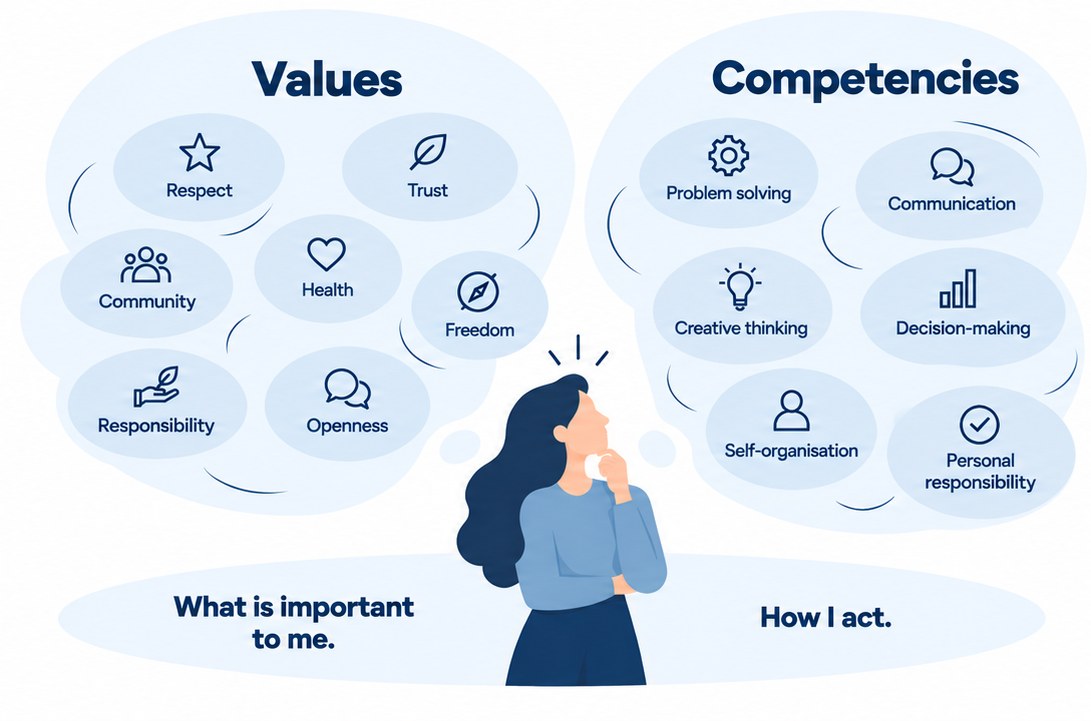
Personality tests measure: "This is how I am"
Traits that are barely changeable. A label whose elements can hardly be developed.
We measure: "This is how I act"
A developable capacity to act. That is the difference between a label and a development path.
A taxonomy that keeps terms apart
Competencies, values and hard skills are handled separately, not thrown into one pot. This makes the suggestions explainable, consistent and multi-tenant-capable – and every assignment can be traced back to a concept in the model instead of a freely invented label.
Many systems let a language model freely interpret what competency means. With us, a researched, published model lies underneath.
The data-based foundation of the suite
Diagnostics
Makes competencies, values and hard skills transparent and deliberately developable.
Learning
Translates the development need into personalized learning paths with practical tasks and projects, social learning, training and further education.
Module 3 · in additionStudio
Delivers didactically and methodically prepared content, even when it starts out unstructured.
Diagnostics can also be used on its own. But the benefit grows significantly once an identified gap turns directly into a learning path, without a detour.
No automated personnel selection
The diagnostics serves development and dialogue, not selection. The decision stays with the human being. Transparent criteria, role-based access, agreed data use.
AI in HR management falls under Annex III of the EU AI Act; the obligations for stand-alone high-risk systems take effect under the Digital Omnibus from 2 December 2027. ValCom is deliberately built so that the decision stays with the human being – not because a regulation demands it, but because a diagnostic that decides about people makes honest self-assessment impossible.
Choose a target role, build a target profile, capture the current state and diagnose
In about 30 minutes, we show you on a real role how a target profile emerges, how the assessment works and which learning paths follow from it.